
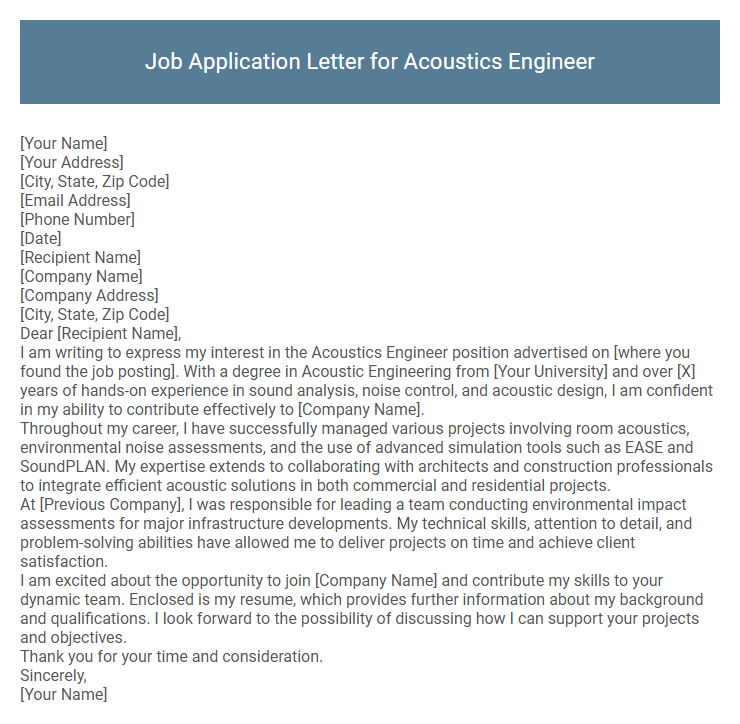
Job Application Letter for Acoustics Engineer Sample
[Your Address]
[City, State, Zip Code]
[Email Address]
[Phone Number]
[Date]
[Recipient Name]
[Company Name]
[Company Address]
[City, State, Zip Code]
Dear [Recipient Name],
I am writing to express my interest in the Acoustics Engineer position advertised on [where you found the job posting]. With a degree in Acoustic Engineering from [Your University] and over [X] years of hands-on experience in sound analysis, noise control, and acoustic design, I am confident in my ability to contribute effectively to [Company Name].
Throughout my career, I have successfully managed various projects involving room acoustics, environmental noise assessments, and the use of advanced simulation tools such as EASE and SoundPLAN. My expertise extends to collaborating with architects and construction professionals to integrate efficient acoustic solutions in both commercial and residential projects.
At [Previous Company], I was responsible for leading a team conducting environmental impact assessments for major infrastructure developments. My technical skills, attention to detail, and problem-solving abilities have allowed me to deliver projects on time and achieve client satisfaction.
I am excited about the opportunity to join [Company Name] and contribute my skills to your dynamic team. Enclosed is my resume, which provides further information about my background and qualifications. I look forward to the possibility of discussing how I can support your projects and objectives.
Thank you for your time and consideration.
Sincerely,
[Your Name]
Crafting a compelling job application letter for an acoustics engineer position highlights your expertise in sound design, noise control, and audio analysis. Emphasizing your technical skills, project experience, and innovative problem-solving abilities can capture the attention of hiring managers seeking professionals in acoustic engineering. Demonstrating your passion for improving sound environments and commitment to advancing acoustic technologies strengthens your candidacy.
What should I include in a job application letter for an Acoustics Engineer position?
Include a clear introduction stating the Acoustics Engineer position you are applying for and how you discovered the opportunity. Highlight relevant skills such as sound analysis, noise control, and experience with acoustic modeling software. Emphasize your accomplishments in previous projects and express enthusiasm for contributing to the company's engineering team.
How do I highlight relevant skills in an Acoustics Engineer application letter?
| Key Skills to Highlight | How to Present in Application Letter |
|---|---|
| Acoustic Modeling | Describe experience with software like EASE, Odeon, or CATT-Acoustic for simulating sound environments. |
| Noise Control | Explain past projects involving noise reduction strategies in industrial, commercial, or residential settings. |
| Sound Measurement & Analysis | Mention expertise in using sound level meters, frequency analyzers, and data interpretation to ensure compliance with standards. |
| Technical Report Writing | Highlight ability to prepare detailed reports, technical documentation, and clear communication with clients and teams. |
| Project Management | Showcase experience managing acoustic projects, coordinating with multidisciplinary teams, and meeting deadlines. |
What is the ideal length for an Acoustics Engineer cover letter?
What is the ideal length for an Acoustics Engineer cover letter? The ideal length for an Acoustics Engineer cover letter is typically one page, containing around 300 to 400 words. This length allows candidates to clearly highlight relevant skills, experience, and accomplishments without overwhelming the hiring manager.
Should I mention certifications in my Acoustics Engineer application letter?
Mentioning certifications in your Acoustics Engineer application letter highlights your specialized skills and industry knowledge.
Certifications demonstrate your commitment to professional development and can set you apart from other candidates.
- Relevance - Include certifications that directly relate to acoustics and engineering principles.
- Credibility - Certifications validate your expertise and technical proficiency to employers.
- Conciseness - Briefly mention certifications without overshadowing your experience and achievements.
How do I address lack of experience in an Acoustics Engineering role?
Addressing a lack of experience in an Acoustics Engineering role requires emphasizing relevant skills and proactive learning efforts. Highlight transferable technical knowledge and enthusiasm for the field to demonstrate potential value to employers.
- Focus on Transferable Skills - Emphasize strong foundations in physics, signal processing, and software tools applicable to acoustics.
- Highlight Academic Projects - Showcase university or independent projects that involved acoustic measurements or simulations.
- Demonstrate Commitment to Growth - Mention certifications, workshops, or self-study initiatives related to acoustics engineering.
Presenting these points confidently shows preparedness despite limited direct experience.
What keywords should I use in an Acoustics Engineer job application letter?
Use keywords such as "acoustic design," "noise control," "sound analysis," "vibration measurement," and "audio signal processing" to highlight relevant technical skills. Include terms like "software proficiency" specifying tools like MATLAB, AutoCAD, or EASE to demonstrate practical expertise. Emphasize "project management," "team collaboration," and "regulatory compliance" to showcase professional competencies.
How do I tailor my cover letter for different Acoustics Engineer job descriptions?
Analyze each Acoustics Engineer job description to identify specific skills, software, and project types requested. Emphasize these elements in your cover letter to match the employer's needs accurately.
Highlight relevant experience such as noise control, sound design, or environmental acoustics aligned with the job requirements. Mention proficiency in industry-standard tools like MATLAB, AutoCAD, or EASE when applicable. Customize your achievements to showcase measurable results that reflect the job's priorities.
Should I include specific project examples in my Acoustics Engineer application letter?
Including specific project examples in your Acoustics Engineer application letter strengthens your candidacy by demonstrating practical experience. Highlighting relevant projects showcases your technical skills and problem-solving abilities directly related to the role.
- Relevance - Including projects aligned with the job role emphasizes your expertise in acoustical design and analysis.
- Impact - Describing outcomes of past projects illustrates your contribution to successful acoustic solutions.
- Credibility - Specific examples provide concrete evidence of your qualifications and technical capabilities.
How should I format a job application letter for Acoustics Engineer positions?
Start your job application letter for an Acoustics Engineer position with a professional header including your contact information, the date, and the employer's details. Open with a clear introduction stating the position you are applying for and a brief summary of your qualifications.
Use the body to highlight relevant skills such as sound measurement, noise control, and experience with acoustic modeling software. Close with a polite call to action, expressing enthusiasm for the opportunity and your availability for an interview.