
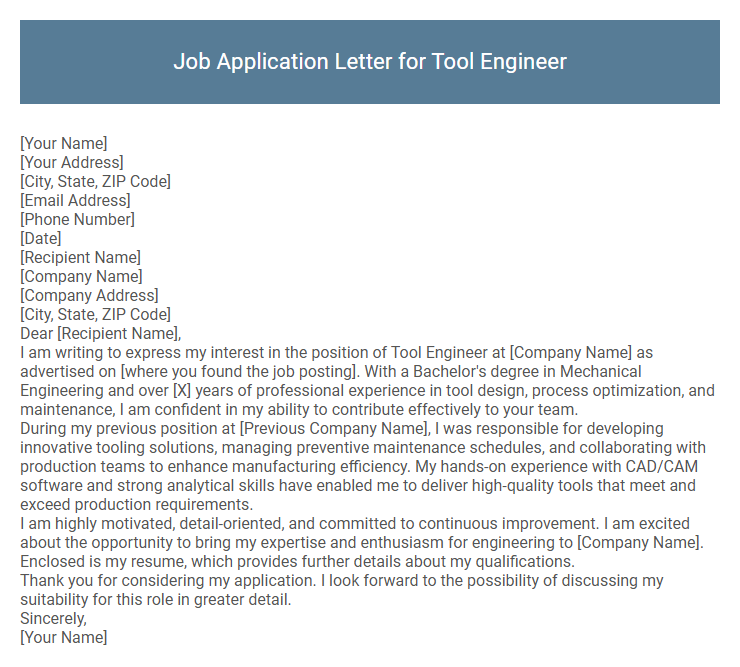
Job Application Letter for Tool Engineer Sample
[Your Address]
[City, State, ZIP Code]
[Email Address]
[Phone Number]
[Date]
[Recipient Name]
[Company Name]
[Company Address]
[City, State, ZIP Code]
Dear [Recipient Name],
I am writing to express my interest in the position of Tool Engineer at [Company Name] as advertised on [where you found the job posting]. With a Bachelor's degree in Mechanical Engineering and over [X] years of professional experience in tool design, process optimization, and maintenance, I am confident in my ability to contribute effectively to your team.
During my previous position at [Previous Company Name], I was responsible for developing innovative tooling solutions, managing preventive maintenance schedules, and collaborating with production teams to enhance manufacturing efficiency. My hands-on experience with CAD/CAM software and strong analytical skills have enabled me to deliver high-quality tools that meet and exceed production requirements.
I am highly motivated, detail-oriented, and committed to continuous improvement. I am excited about the opportunity to bring my expertise and enthusiasm for engineering to [Company Name]. Enclosed is my resume, which provides further details about my qualifications.
Thank you for considering my application. I look forward to the possibility of discussing my suitability for this role in greater detail.
Sincerely,
[Your Name]
Crafting a compelling job application letter for a Tool Engineer requires highlighting technical expertise, problem-solving skills, and experience with tool design and maintenance. Emphasizing proficiency in CAD software and knowledge of manufacturing processes can demonstrate suitability for the role. Showcasing a commitment to innovation and efficiency helps attract potential employers in this competitive field.
What should I include in a job application letter for a Tool Engineer position?
Include a clear introduction stating your interest in the Tool Engineer position and how your skills match the job requirements. Highlight relevant technical expertise such as CAD software proficiency, tooling design experience, and problem-solving abilities. Conclude with a confident statement expressing your enthusiasm for contributing to the company's engineering projects.
How do I highlight my tool engineering skills in the letter?
Emphasize your proficiency in CAD software, tool design, and maintenance to showcase your technical expertise. Highlight successful projects where you optimized tool performance or reduced production downtime. Mention certifications or hands-on experience with industry-standard tools to reinforce your qualifications.
What is the ideal length for a Tool Engineer application letter?
| Aspect | Details |
|---|---|
| Ideal Length | 250 to 350 words |
| Reason | Concise detail of skills and experience without overwhelming |
| Structure | Introduction, relevant experience, technical skills, and closing |
| Focus | Highlight practical engineering achievements and tool design expertise |
| Format | One page, clear paragraphs, professional tone |
Should I mention specific tools or software I have experience with?
Including specific tools or software experience in a job application letter for a Tool Engineer highlights relevant skills directly related to the role. Mentioning these details can demonstrate proficiency and increase the chances of catching the employer's attention.
- Relevance to Job Description - Tailor your mention of tools and software to match the requirements listed in the job posting to show alignment with the employer's needs.
- Highlight Key Competencies - Naming software like AutoCAD, SolidWorks, or CNC programming tools emphasizes technical expertise essential for a Tool Engineer.
- Showcase Practical Experience - Specific examples of tools used in past projects provide concrete evidence of your hands-on experience and problem-solving abilities.
How do I showcase my problem-solving abilities in my letter?
Highlight specific instances where you identified and resolved technical challenges in previous projects. Emphasize your analytical skills and innovative approaches to improving tool design or functionality.
- Describe a challenge - Explain a complex tooling problem you encountered and the method you used to analyze it.
- Detail your solution - Showcase the creative or technical strategy you implemented to solve the issue effectively.
- Quantify results - Provide measurable outcomes such as increased efficiency or cost savings resulting from your solution.
Is it necessary to address the letter to a specific person or department?
Addressing a job application letter for a Tool Engineer to a specific person or department enhances personalization and shows attention to detail. It can increase the chances of the letter being noticed and taken seriously by the hiring team.
If the specific contact is unavailable, directing the letter to the Human Resources department or the hiring manager is advisable. This approach ensures the application reaches the appropriate decision-makers effectively.
Should I include certifications or licenses in my application letter?
Including certifications or licenses in your job application letter for a Tool Engineer can strengthen your candidacy by highlighting relevant qualifications. Certifications such as CNC programming, CAD software proficiency, or safety licenses demonstrate specialized skills and industry knowledge. Mentioning these credentials briefly in the letter shows your commitment to professional development and aligns with employer expectations.
How do I describe my previous Tool Engineer projects effectively?
How do I describe my previous Tool Engineer projects effectively?
Highlight the specific tools and technologies you used in each project, emphasizing your role and contributions. Quantify achievements such as efficiency improvements, cost savings, or production enhancements to demonstrate impact clearly.
What format or structure should I use for the job application letter?
Start with a professional header including your contact information, the employer's details, and the date. Begin the letter with a formal salutation, followed by an introduction stating the job position you are applying for and a brief summary of your relevant experience. Conclude with paragraphs highlighting your key skills, expressing enthusiasm for the role, and a courteous closing with a call to action for an interview.