
Job Application Letter for Acoustic Engineer Sample
[Your Address]
[City, State, ZIP Code]
[Email Address]
[Phone Number]
[Date]
[Hiring Manager's Name]
[Company Name]
[Company Address]
[City, State, ZIP Code]
Dear [Hiring Manager's Name],
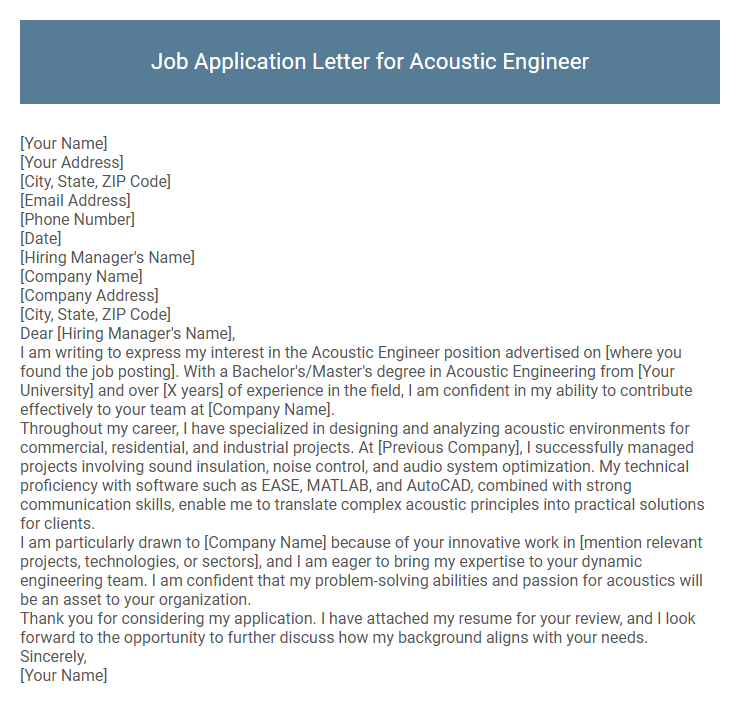
I am writing to express my interest in the Acoustic Engineer position advertised on [where you found the job posting]. With a Bachelor's/Master's degree in Acoustic Engineering from [Your University] and over [X years] of experience in the field, I am confident in my ability to contribute effectively to your team at [Company Name].
Throughout my career, I have specialized in designing and analyzing acoustic environments for commercial, residential, and industrial projects. At [Previous Company], I successfully managed projects involving sound insulation, noise control, and audio system optimization. My technical proficiency with software such as EASE, MATLAB, and AutoCAD, combined with strong communication skills, enable me to translate complex acoustic principles into practical solutions for clients.
I am particularly drawn to [Company Name] because of your innovative work in [mention relevant projects, technologies, or sectors], and I am eager to bring my expertise to your dynamic engineering team. I am confident that my problem-solving abilities and passion for acoustics will be an asset to your organization.
Thank you for considering my application. I have attached my resume for your review, and I look forward to the opportunity to further discuss how my background aligns with your needs.
Sincerely,
[Your Name]
Crafting a precise and compelling job application letter is essential for acoustic engineers seeking to demonstrate their expertise in sound design and noise control. Highlighting relevant technical skills, project experience, and familiarity with industry standards can significantly enhance the impact of the application. Tailoring the letter to reflect an understanding of the company's specific acoustic challenges showcases both professionalism and commitment.
What should I include in a job application letter for an Acoustic Engineer position?
Include a clear introduction stating the Acoustic Engineer position you are applying for and where you found the job listing. Highlight your relevant skills, such as experience with sound measurement, acoustic modeling software, and noise control techniques. Conclude with a strong statement expressing your enthusiasm for the role and how your expertise can contribute to the company's projects.
How do I highlight my acoustic engineering skills in the letter?
Emphasize specific acoustic engineering projects where you applied sound design, noise control, or vibration analysis techniques to achieve measurable improvements. Highlight proficiency with industry-standard tools like MATLAB, AutoCAD, or acoustic simulation software, showcasing your ability to develop innovative solutions. Mention any certifications or professional experience that demonstrate your expertise in acoustic principles and effective communication of technical findings to multidisciplinary teams.
Should I mention specific acoustic software proficiency?
Mentioning specific acoustic software proficiency in a job application letter for an Acoustic Engineer is crucial. Highlighting tools like EASE, SoundPLAN, or Odeon demonstrates technical expertise and aligns your skills with job requirements. Emphasizing software knowledge increases your chances of standing out to hiring managers seeking specialized capabilities.
How do I address my experience with noise control or sound analysis?
In my previous roles, I have successfully designed and implemented noise control solutions for various industrial and architectural projects, significantly reducing sound pollution levels. My expertise includes conducting detailed sound analysis using advanced acoustic measurement tools and software to diagnose and mitigate noise issues.
I have worked closely with multidisciplinary teams to develop customized acoustic treatments, ensuring compliance with regulatory standards and client specifications. These experiences have honed my ability to deliver precise acoustic engineering solutions for optimal sound quality and noise reduction.
Is it important to mention team collaboration in acoustic projects?
Mentioning team collaboration in a job application letter for an Acoustic Engineer is crucial. Acoustic projects often require interdisciplinary teamwork to achieve optimal sound design and problem-solving.
Highlighting your ability to work effectively with architects, engineers, and clients demonstrates strong interpersonal skills and adaptability. It shows you can contribute to project success beyond technical expertise. Employers value candidates who can integrate acoustics within a broader project framework.
Do I need to tailor my letter for each company?
Tailoring your job application letter for each acoustic engineer position improves your chances of securing an interview. Customization highlights your relevant skills and aligns your experience with the specific company's needs.
- Company Research - Investigate each company's projects and values to align your letter's tone and content.
- Highlight Relevant Expertise - Emphasize acoustic engineering skills that match the job description and company focus areas.
- Demonstrate Cultural Fit - Show understanding of the company's mission and explain how your goals resonate with their culture.
How do I show my passion for acoustic engineering in my application?
Express your enthusiasm for acoustic engineering by highlighting specific projects or research that sparked your interest in sound design and noise control. Mention any relevant experiences, such as internships, academic achievements, or hands-on work, that demonstrate your commitment to advancing acoustic technology. Emphasize your desire to contribute innovative solutions and improve auditory environments through your skills and knowledge in this field.
What academic qualifications should I reference?
Highlight a bachelor's degree in acoustical engineering, mechanical engineering, or a related field such as physics or electrical engineering. Mention any advanced degrees like a master's or Ph.D. specializing in acoustics or sound engineering to demonstrate deeper expertise.
Include certifications such as Certified Professional in Acoustics (CPA) or relevant coursework in signal processing, noise control, or architectural acoustics. Emphasize practical experience gained through academic projects or internships related to acoustic system design and analysis.
Should I include certifications relevant to acoustics?
| Aspect | Recommendation |
|---|---|
| Certifications Relevant to Acoustics | Including certifications such as Certified Acoustic Engineer (CAE), Audio Engineering Society (AES) membership, or specialized training in noise control, sound design, and vibration analysis strengthens the application. |
| Purpose of Including Certifications | Certifications validate technical expertise and commitment to the field of acoustics, increasing credibility with employers. |
| Location in Application Letter | List certifications in a dedicated section near the professional summary or skills area for maximum impact. |
| Effect on Hiring Decision | Relevant certifications often influence shortlisting by demonstrating specialized knowledge beyond academic qualifications. |
| Additional Suggestions | Mentioning ongoing professional development courses or workshops related to acoustics shows continuous skill improvement. |