
Job Application Letter for Radio Engineer Sample
[Your Address]
[City, State, ZIP Code]
[Email Address]
[Phone Number]
[Date]
[Recipient's Name]
[Company/Station Name]
[Company Address]
[City, State, ZIP Code]
Dear [Recipient's Name],
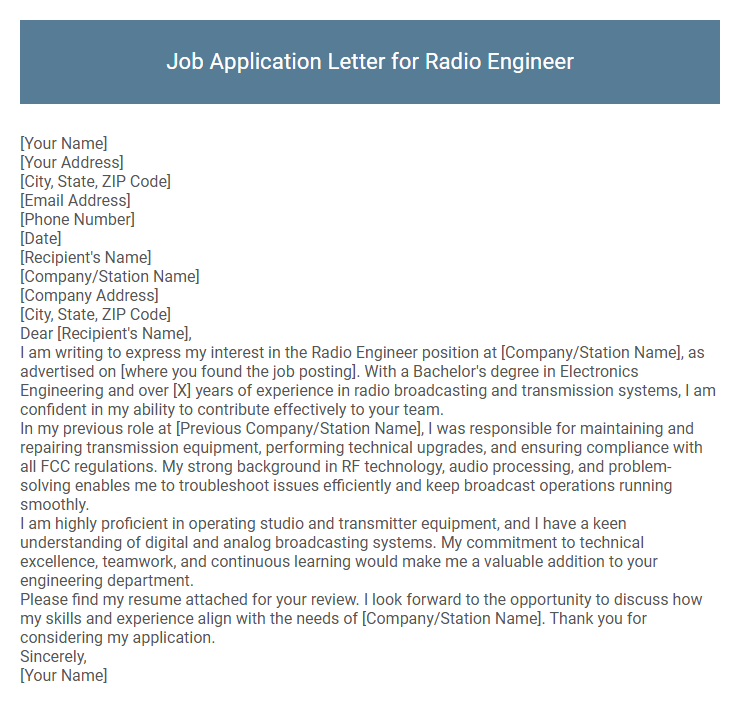
I am writing to express my interest in the Radio Engineer position at [Company/Station Name], as advertised on [where you found the job posting]. With a Bachelor's degree in Electronics Engineering and over [X] years of experience in radio broadcasting and transmission systems, I am confident in my ability to contribute effectively to your team.
In my previous role at [Previous Company/Station Name], I was responsible for maintaining and repairing transmission equipment, performing technical upgrades, and ensuring compliance with all FCC regulations. My strong background in RF technology, audio processing, and problem-solving enables me to troubleshoot issues efficiently and keep broadcast operations running smoothly.
I am highly proficient in operating studio and transmitter equipment, and I have a keen understanding of digital and analog broadcasting systems. My commitment to technical excellence, teamwork, and continuous learning would make me a valuable addition to your engineering department.
Please find my resume attached for your review. I look forward to the opportunity to discuss how my skills and experience align with the needs of [Company/Station Name]. Thank you for considering my application.
Sincerely,
[Your Name]
A job application letter for a radio engineer highlights specialized skills in designing, implementing, and maintaining radio communication systems. Emphasizing expertise in signal processing, troubleshooting, and adherence to industry standards strengthens the candidate's profile. Clear presentation of qualifications and relevant experience attracts potential employers in the telecommunications sector.
What key skills should a Radio Engineer highlight in a job application letter?
A Radio Engineer should highlight key skills such as expertise in RF system design, troubleshooting, and maintenance of radio communication equipment. Proficiency in signal processing, spectrum analysis, and knowledge of regulatory standards is essential. Strong analytical abilities, attention to detail, and experience with wireless network optimization must also be emphasized.
How should I structure my job application letter as a Radio Engineer?
Begin your job application letter as a Radio Engineer with a strong introduction stating your interest in the position and a brief overview of your technical expertise in radio frequency systems and communication technologies.
Highlight your relevant experience, key skills such as signal analysis, equipment maintenance, and troubleshooting, and any certifications or projects demonstrating your proficiency in radio engineering.
Conclude with a confident closing that expresses your enthusiasm for contributing to the company, along with a call to action for an interview or further discussion.
What technical qualifications are most relevant for Radio Engineer roles?
Radio Engineer job applications demand a strong foundation in electronic communication principles and hands-on experience with radio frequency systems. Understanding technical qualifications critical to the role enhances the effectiveness of the application letter.
- Proficiency in Radio Frequency (RF) Engineering - Expertise in RF signal propagation, modulation, and antenna design is essential for optimizing radio communication systems.
- Knowledge of Communication Protocols - Familiarity with protocols such as LTE, 5G, and satellite communication ensures efficient system configuration and troubleshooting.
- Experience with Diagnostic Tools - Skill in using spectrum analyzers, network analyzers, and oscilloscopes is crucial for identifying and resolving radio frequency issues.
Should I mention specific radio communication systems I've worked with?
Mentioning specific radio communication systems you have worked with in your job application letter for a Radio Engineer position is highly beneficial. It demonstrates your technical expertise and relevance to the employer's needs.
Detailing systems like VHF/UHF radios, microwave links, or satellite communication equipment can highlight your hands-on experience and problem-solving skills. Tailor these examples to the job description to make your application stand out. Clearly showing familiarity with industry-standard technology increases your chances of being shortlisted.
How do I demonstrate problem-solving experience in my application letter?
Highlight specific projects where you identified technical issues and implemented effective solutions, emphasizing your analytical skills. Describe situations where you collaborated with a team to troubleshoot and resolve complex radio engineering problems. Showcase measurable outcomes, such as improved signal quality or reduced downtime, to demonstrate your problem-solving impact.
What educational background should I include for a Radio Engineer position?
A Radio Engineer should highlight a bachelor's degree in Electrical Engineering, Telecommunications Engineering, or a related field. Including specialized coursework in radio frequency (RF) engineering, signal processing, and wireless communications strengthens the application.
Certifications such as Certified Radio Frequency Engineer (CRFE) or knowledge of industry standards like IEEE and FCC regulations add value. Practical experience through internships or projects involving RF systems and radio network design is essential to demonstrate technical proficiency.
Is it important to tailor my cover letter for each radio company?
Tailoring your job application letter for each radio company significantly increases your chances of standing out. Highlighting specific skills and experiences relevant to the company's projects demonstrates genuine interest and understanding of their needs. Customized cover letters show professionalism and a strong alignment with the company's goals, making your application more compelling.
How can I show my familiarity with industry standards in my letter?
Demonstrate your knowledge of industry standards by referencing specific protocols and certifications relevant to radio engineering. Highlight your experience applying these standards in practical settings to assure compliance and technical excellence.
- Mention Relevant Certifications - Include certifications like FCC licensing or ANSI standards to validate your expertise.
- Reference Industry Protocols - Cite familiarity with protocols such as IEEE 802.11 or 3GPP standards to align with current technologies.
- Describe Practical Application - Provide examples of projects where you implemented regulatory guidelines to ensure equipment safety and performance.
Should I include project or fieldwork examples in a Radio Engineer application?
Should I include project or fieldwork examples in a Radio Engineer application? Including specific projects or fieldwork demonstrates practical experience and technical skills relevant to radio engineering. It helps employers assess your ability to handle real-world challenges and deliver results.