
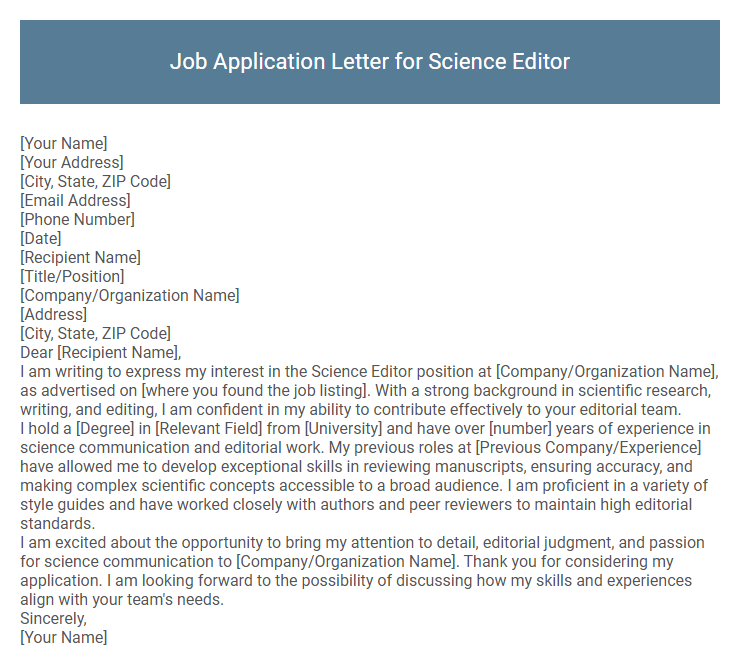
Job Application Letter for Science Editor Sample
[Your Address]
[City, State, ZIP Code]
[Email Address]
[Phone Number]
[Date]
[Recipient Name]
[Title/Position]
[Company/Organization Name]
[Address]
[City, State, ZIP Code]
Dear [Recipient Name],
I am writing to express my interest in the Science Editor position at [Company/Organization Name], as advertised on [where you found the job listing]. With a strong background in scientific research, writing, and editing, I am confident in my ability to contribute effectively to your editorial team.
I hold a [Degree] in [Relevant Field] from [University] and have over [number] years of experience in science communication and editorial work. My previous roles at [Previous Company/Experience] have allowed me to develop exceptional skills in reviewing manuscripts, ensuring accuracy, and making complex scientific concepts accessible to a broad audience. I am proficient in a variety of style guides and have worked closely with authors and peer reviewers to maintain high editorial standards.
I am excited about the opportunity to bring my attention to detail, editorial judgment, and passion for science communication to [Company/Organization Name]. Thank you for considering my application. I am looking forward to the possibility of discussing how my skills and experiences align with your team's needs.
Sincerely,
[Your Name]
Crafting a compelling job application letter for a science editor requires highlighting a strong background in scientific research and exceptional editorial skills. Emphasizing experience in managing complex manuscripts, ensuring accuracy, and maintaining clarity helps demonstrate suitability for the role. Showcasing a passion for advancing scientific communication and attention to detail enhances the letter's impact.
What should I include in my job application letter for a science editor position?
Include your relevant academic background and experience in scientific writing or editing to demonstrate expertise. Highlight specific skills such as attention to detail, proficiency with scientific terminology, and familiarity with editorial tools. Emphasize your ability to manage deadlines, collaborate with researchers, and improve the clarity and accuracy of scientific content.
How do I highlight my science editing experience in the letter?
Highlight your science editing experience by specifying the types of scientific manuscripts and journals you have worked with, emphasizing your familiarity with technical terminology and research methodologies. Mention your proficiency in ensuring clarity, accuracy, and consistency in complex scientific texts, which enhances the dissemination of research findings. Include examples of successful collaborations with researchers or editorial teams that demonstrate your ability to manage and improve scientific content effectively.
What qualifications are important to mention for a science editor role?
What qualifications are important to mention for a science editor role? Highlight a strong background in scientific disciplines such as biology, chemistry, or physics, combined with excellent editorial skills. Experience with peer-reviewed publications and proficiency in scientific writing standards are essential.
How does expertise in scientific research benefit a science editor? It enables accurate assessment of research validity and methodology. This expertise ensures the clarity and reliability of published scientific content.
Why is proficiency in language and communication critical for a science editor? Clear, concise, and precise language is necessary for conveying complex scientific ideas effectively. Strong communication skills aid in collaborating with authors and reviewers.
What technical skills should a science editor emphasize in their application? Familiarity with manuscript management systems, referencing software, and data presentation tools is advantageous. Knowledge of publication ethics and copyright regulations is also important.
How important is experience in peer review for a science editor position? Experience managing or participating in the peer review process demonstrates understanding of quality control in scientific publishing. It highlights the ability to maintain high editorial standards and integrity.
Should I customize my application letter for each employer?
Customizing your job application letter for each employer enhances your chances of standing out by addressing specific job requirements and company values. Tailored letters demonstrate genuine interest and show that you understand the employer's unique needs.
A generic letter may overlook key qualifications or fail to connect your skills with the employer's goals. Personalizing your application reflects professionalism and increases the likelihood of securing an interview.
How long should my science editor job application letter be?
Your science editor job application letter should be concise, ideally between 250 to 400 words. This length allows you to effectively highlight your qualifications without overwhelming the reader.
Focus on demonstrating your expertise in scientific editing, attention to detail, and relevant experience. Keep the letter clear and targeted to maintain the employer's interest throughout.
Is it necessary to mention specific scientific fields or journals I have worked with?
| Aspect | Details |
|---|---|
| Relevance | Mentioning specific scientific fields highlights your area of expertise, aligning your skills with the employer's needs. |
| Credibility | Listing journals you have worked with demonstrates your familiarity with academic publishing standards and enhances your credibility. |
| Customization | Tailoring the letter with relevant fields and journals shows attention to the job description and strengthens your application. |
| Detail Level | Include significant scientific fields and reputable journals; avoid excessive listing to maintain clarity and impact. |
| Overall Benefit | Mentioning specific fields and journals boosts chances of being shortlisted by showcasing specialized experience. |
How do I address the letter if I don't know the recruiter's name?
Addressing a job application letter without the recruiter's name requires professionalism and clarity. Choosing the right salutation can set a positive tone for your Science Editor application.
- Use a generic professional greeting - Start with "Dear Hiring Manager" to maintain formality without specifying a name.
- Reference the department or role - Address the letter to "Editorial Team" or "Science Editing Department" if applicable to personalize while remaining professional.
- Avoid informal greetings - Do not use "To Whom It May Concern" as it may appear outdated and impersonal, reducing engagement.
Can I use bullet points in a science editor job application letter?
Using bullet points in a science editor job application letter can enhance clarity and highlight key qualifications effectively. Well-structured bullet points help hiring managers quickly identify relevant skills and experiences.
- Improves Readability - Bullet points break down complex information into digestible segments for easier review.
- Highlights Key Skills - They emphasize important qualifications such as editing experience, scientific knowledge, and attention to detail.
- Keeps the Letter Concise - Bullets prevent lengthy paragraphs and maintain a professional tone suitable for scientific roles.
Incorporating bullet points thoughtfully can strengthen your science editor application by making your strengths stand out clearly.
Should I include links to my published work or portfolio?
Including links to your published work or portfolio in a job application letter for a Science Editor position can significantly enhance your credibility and showcase your expertise. These links provide concrete evidence of your editing skills and subject matter knowledge, making your application stand out. Ensure the links are relevant, accessible, and professionally presented to strengthen your candidacy effectively.