
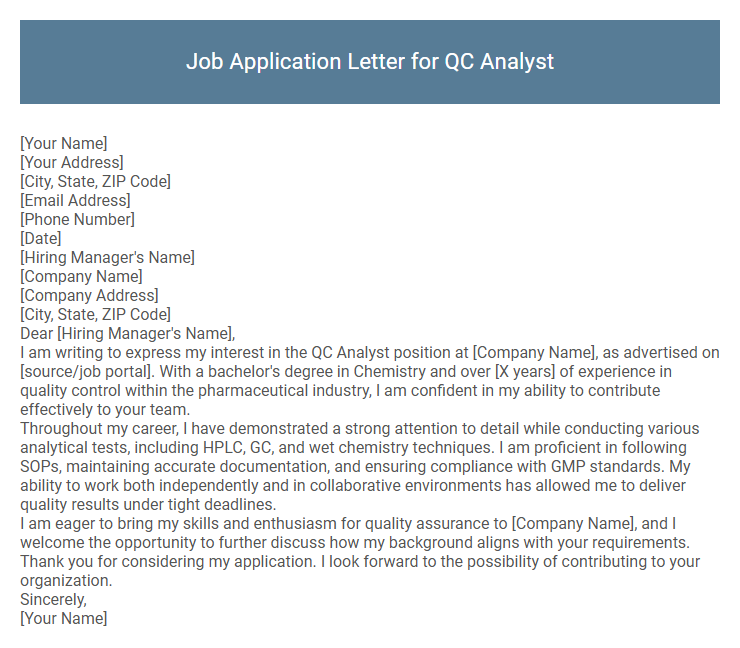
Job Application Letter for QC Analyst Sample
[Your Address]
[City, State, ZIP Code]
[Email Address]
[Phone Number]
[Date]
[Hiring Manager's Name]
[Company Name]
[Company Address]
[City, State, ZIP Code]
Dear [Hiring Manager's Name],
I am writing to express my interest in the QC Analyst position at [Company Name], as advertised on [source/job portal]. With a bachelor's degree in Chemistry and over [X years] of experience in quality control within the pharmaceutical industry, I am confident in my ability to contribute effectively to your team.
Throughout my career, I have demonstrated a strong attention to detail while conducting various analytical tests, including HPLC, GC, and wet chemistry techniques. I am proficient in following SOPs, maintaining accurate documentation, and ensuring compliance with GMP standards. My ability to work both independently and in collaborative environments has allowed me to deliver quality results under tight deadlines.
I am eager to bring my skills and enthusiasm for quality assurance to [Company Name], and I welcome the opportunity to further discuss how my background aligns with your requirements.
Thank you for considering my application. I look forward to the possibility of contributing to your organization.
Sincerely,
[Your Name]
A job application letter for a QC Analyst highlights key qualifications in quality control, data analysis, and adherence to regulatory standards. Demonstrating expertise in product testing, process improvement, and problem-solving attracts employer interest in ensuring high-quality outputs. Clear communication of analytical skills and attention to detail positions candidates as valuable assets in maintaining quality assurance.
What should I include in a QC Analyst job application letter?
Include your relevant experience in quality control processes, laboratory techniques, and compliance with industry standards. Highlight your analytical skills, attention to detail, and ability to perform data interpretation and problem-solving. Emphasize your knowledge of regulatory guidelines, such as GMP or ISO, and your commitment to maintaining product quality and safety.
How do I highlight my QC skills in the application letter?
Highlight your expertise in quality control by detailing specific techniques and tools you have mastered, such as HPLC, GC, and ISO standards. Emphasize your ability to analyze data accurately, ensure compliance with regulatory requirements, and maintain meticulous documentation. Showcase examples of problem-solving and improving processes to demonstrate your value as a QC Analyst.
Is it necessary to mention lab equipment experience?
Including lab equipment experience in a job application letter for a QC Analyst is important as it highlights technical proficiency relevant to quality control tasks. Employers prioritize candidates familiar with specific instruments used in the lab for accurate testing and analysis. Mentioning this experience increases the chances of standing out in a competitive job market.
Should I list certifications in my job application letter?
Should I list certifications in my job application letter for a QC Analyst position? Including relevant certifications highlights your specialized skills and enhances your credibility. Certifications like Six Sigma, ISO 9001, or laboratory safety demonstrate your expertise and commitment to quality control standards.
How do I tailor my letter for a pharmaceutical company?
Highlight your experience with quality control processes, regulatory compliance, and analytical techniques specific to pharmaceutical standards. Emphasize your knowledge of GMP, FDA regulations, and your ability to maintain product safety and efficacy.
Showcase relevant certifications and familiarity with laboratory instruments commonly used in pharmaceutical QC. Customize your letter by addressing the company's mission and how your skills align with their quality assurance objectives.
What is the ideal length for a QC Analyst cover letter?
The ideal length for a QC Analyst cover letter is concise, typically one page, to maintain the hiring manager's attention. It should clearly highlight relevant skills and experience without being overly detailed.
- Conciseness - Keep the cover letter to one page, about 250-400 words, to ensure readability and engagement.
- Relevance - Focus on key qualifications and accomplishments that align with the QC Analyst role.
- Clarity - Use clear, precise language that demonstrates your expertise in quality control processes and analytical skills.
Can I use bullet points in my application letter?
Using bullet points in a job application letter for a QC Analyst position is acceptable if they clearly highlight key skills and achievements related to quality control. Bullet points improve readability and help recruiters quickly identify your qualifications, such as experience with analytical instruments, data accuracy, and regulatory compliance. Ensure the bullet points are concise and relevant to the job description to make a strong impact.
How do I address lack of experience in QC analysis?
When addressing a lack of experience in QC analysis within a job application letter, highlight your relevant skills and willingness to learn. Demonstrate your understanding of quality control principles and emphasize any related practical exposure.
- Transferable Skills - Showcase skills like attention to detail, data analysis, and problem-solving gained from academic or other professional experiences.
- Relevant Training - Mention any certifications, courses, or workshops completed in quality control or analytical techniques.
- Enthusiasm to Learn - Express your commitment to rapidly acquiring hands-on experience and contributing effectively to the QC team.
Frame your potential as an asset by focusing on your adaptability and proactive learning approach in QC environments.
What achievements should I mention as a QC Analyst?
Mention achievements that demonstrate your expertise in quality control processes, such as successfully reducing product defects by a significant percentage. Highlight your role in implementing new testing protocols that improved overall product reliability.
Include specific examples like leading a project that enhanced testing accuracy through advanced analytical techniques. Emphasize your contribution to maintaining compliance with regulatory standards and passing audits without findings. Showcase your ability to train team members, resulting in increased department efficiency and quality output.