
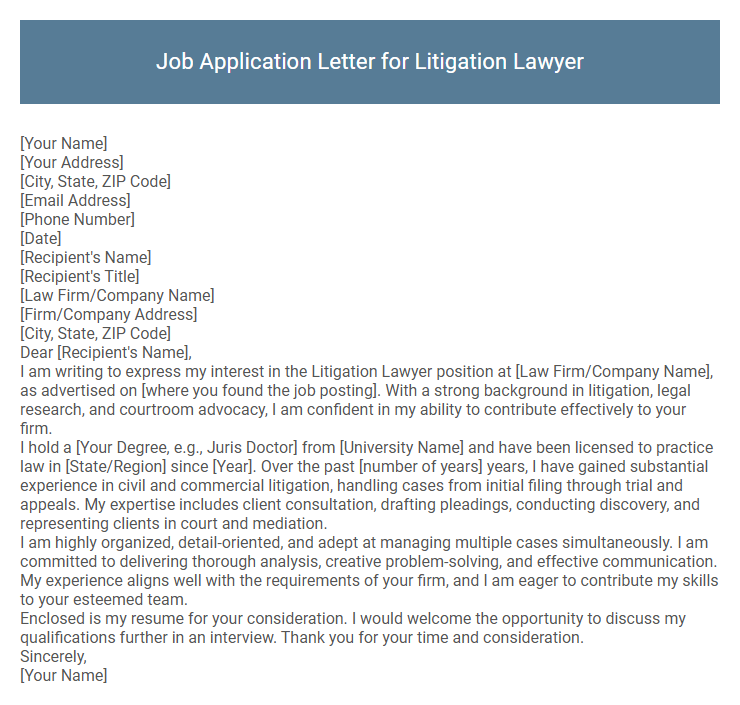
Job Application Letter for Litigation Lawyer Sample
[Your Address]
[City, State, ZIP Code]
[Email Address]
[Phone Number]
[Date]
[Recipient's Name]
[Recipient's Title]
[Law Firm/Company Name]
[Firm/Company Address]
[City, State, ZIP Code]
Dear [Recipient's Name],
I am writing to express my interest in the Litigation Lawyer position at [Law Firm/Company Name], as advertised on [where you found the job posting]. With a strong background in litigation, legal research, and courtroom advocacy, I am confident in my ability to contribute effectively to your firm.
I hold a [Your Degree, e.g., Juris Doctor] from [University Name] and have been licensed to practice law in [State/Region] since [Year]. Over the past [number of years] years, I have gained substantial experience in civil and commercial litigation, handling cases from initial filing through trial and appeals. My expertise includes client consultation, drafting pleadings, conducting discovery, and representing clients in court and mediation.
I am highly organized, detail-oriented, and adept at managing multiple cases simultaneously. I am committed to delivering thorough analysis, creative problem-solving, and effective communication. My experience aligns well with the requirements of your firm, and I am eager to contribute my skills to your esteemed team.
Enclosed is my resume for your consideration. I would welcome the opportunity to discuss my qualifications further in an interview. Thank you for your time and consideration.
Sincerely,
[Your Name]
Applying for a litigation lawyer position requires a clear demonstration of legal expertise, strong analytical skills, and effective courtroom experience. A well-crafted job application letter highlights a candidate's ability to manage complex cases, advocate persuasively for clients, and navigate the litigation process efficiently. Emphasizing achievements in resolving disputes and a commitment to justice can set an application apart in this competitive field.
What key qualifications should I highlight in a litigation lawyer application letter?
Highlight a strong understanding of legal procedures and courtroom experience to demonstrate practical litigation skills. Emphasize excellent research, negotiation, and communication abilities to effectively advocate for clients. Showcase a track record of successful case outcomes and proficiency in managing complex legal disputes.
How do I structure a job application letter for a litigation lawyer position?
Begin your job application letter for a litigation lawyer position with a clear introduction stating the role you are applying for and a brief overview of your legal background. Highlight your key qualifications and years of experience in litigation to capture the employer's interest.
Follow with detailed examples of relevant cases or legal achievements that demonstrate your skills in litigation, negotiation, and courtroom performance. Conclude by expressing your enthusiasm for the role and your availability for an interview to discuss how you can contribute to the firm's success.
Is it necessary to mention specific litigation cases in my cover letter?
Mentioning specific litigation cases in your job application letter can showcase your expertise and add credibility to your claim of experience. Highlighting notable cases demonstrates your ability to handle complex legal matters and aligns your skills with the employer's needs. Keep the details concise and relevant to emphasize your qualifications without overwhelming the reader.
Should I address the letter to a specific person or use a general greeting?
Addressing a job application letter for a litigation lawyer position to a specific person demonstrates professionalism and attention to detail. It shows you have researched the firm and personalized your application.
If you cannot find a specific name, using a general greeting such as "Dear Hiring Manager" is acceptable. Avoid generic phrases like "To whom it may concern" to maintain formality and respect.
How long should a litigation lawyer application letter be?
A litigation lawyer application letter should be concise, ideally between 250 to 400 words. Keeping it to one page ensures clarity and maintains the reader's attention.
Focus on relevant experience, key skills, and specific achievements that demonstrate your litigation expertise. Highlight understanding of court procedures, strong research, and negotiation abilities. Tailor the letter to the law firm's requirements, making every sentence impactful and purposeful.
What tone is appropriate for a litigation lawyer cover letter?
What tone is appropriate for a litigation lawyer cover letter? A litigation lawyer cover letter should maintain a professional and confident tone. It must convey clear communication skills and assertiveness without sounding aggressive or arrogant.
Do I need to mention bar admission in my application letter?
Mentioning bar admission in a job application letter for a litigation lawyer is essential. It confirms your legal qualification and eligibility to practice law within the relevant jurisdiction.
- Proof of Qualification - Bar admission verifies that you have met the necessary legal education and examination requirements to practice law professionally.
- Jurisdiction Relevance - Including your bar admission shows you are authorized to represent clients in the specific court systems related to the litigation role.
- Enhances Credibility - Highlighting your bar status builds trust with potential employers, demonstrating your commitment and legitimacy as a litigation lawyer.
Should I include references in the job application letter?
Including references in a job application letter for a litigation lawyer position is generally not necessary unless explicitly requested by the employer. Focus on highlighting your legal experience, case successes, and relevant skills in the letter. Prepare a separate reference list to provide upon request during later stages of the hiring process.
How can I demonstrate strong advocacy skills in my letter?
Emphasize specific cases where you successfully represented clients and achieved favorable outcomes. Highlight your ability to analyze complex legal issues and present compelling arguments in court.
- Case Success - Detail a precedent-setting case or a high-stakes trial where your advocacy secured a win.
- Legal Expertise - Showcase your skill in interpreting laws and applying them persuasively to support your client's position.
- Communication Skills - Illustrate your effectiveness in delivering clear and convincing oral and written arguments to judges and juries.