
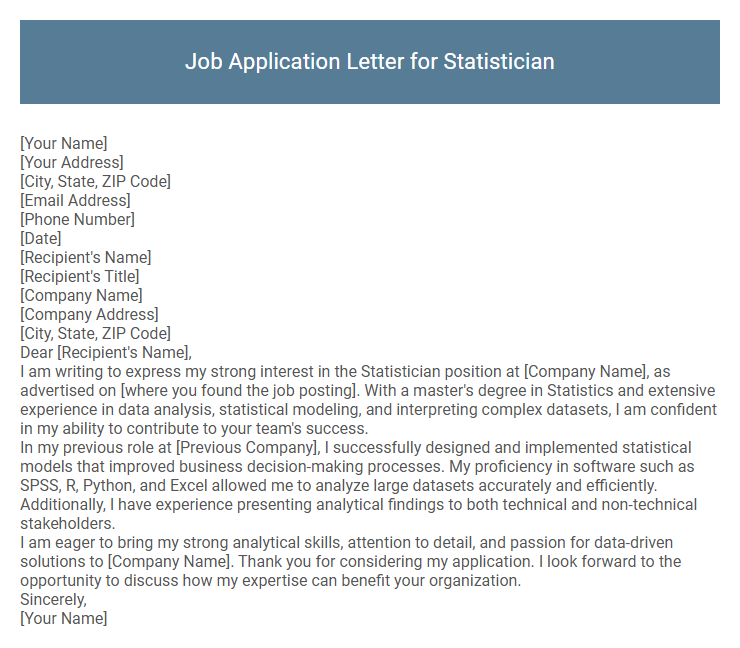
Job Application Letter for Statistician Sample
[Your Address]
[City, State, ZIP Code]
[Email Address]
[Phone Number]
[Date]
[Recipient's Name]
[Recipient's Title]
[Company Name]
[Company Address]
[City, State, ZIP Code]
Dear [Recipient's Name],
I am writing to express my strong interest in the Statistician position at [Company Name], as advertised on [where you found the job posting]. With a master's degree in Statistics and extensive experience in data analysis, statistical modeling, and interpreting complex datasets, I am confident in my ability to contribute to your team's success.
In my previous role at [Previous Company], I successfully designed and implemented statistical models that improved business decision-making processes. My proficiency in software such as SPSS, R, Python, and Excel allowed me to analyze large datasets accurately and efficiently. Additionally, I have experience presenting analytical findings to both technical and non-technical stakeholders.
I am eager to bring my strong analytical skills, attention to detail, and passion for data-driven solutions to [Company Name]. Thank you for considering my application. I look forward to the opportunity to discuss how my expertise can benefit your organization.
Sincerely,
[Your Name]
A well-crafted job application letter for a statistician highlights expertise in data analysis, statistical modeling, and interpretation. Emphasizing proficiency in software tools like R, SAS, or Python demonstrates technical competence essential for making data-driven decisions. Showcasing experience in translating complex data into actionable insights captures the attention of employers seeking analytical problem solvers.
What should I include in a statistician job application letter?
Include a clear statement of your statistical expertise and relevant experience, such as proficiency in data analysis software like R, SAS, or Python. Highlight your ability to interpret complex data sets and provide actionable insights to support decision-making. Emphasize your problem-solving skills and any specific achievements related to statistical projects or research.
How do I highlight relevant statistical skills in my letter?
Highlight relevant statistical skills by mentioning specific methodologies such as regression analysis, hypothesis testing, and data modeling. Emphasize proficiency in statistical software like R, SAS, or Python to demonstrate hands-on expertise.
Provide examples of past projects where you applied these skills to solve real-world problems or improve decision-making. Quantify achievements with metrics like increased accuracy or reduced processing time. Tailor the skills to match the job description for maximum impact.
What is the ideal length for a statistician application letter?
The ideal length for a statistician application letter is typically one page, consisting of 3 to 4 concise paragraphs. It should clearly highlight relevant skills, experience with statistical software, and key achievements without overwhelming the reader. Keeping it brief ensures readability and effectively communicates qualifications to hiring managers in the data and analytics field.
Should I mention specific statistical tools or software?
| Aspect | Recommendation |
|---|---|
| Relevance | Mention specific statistical tools or software only if required in the job description or highly relevant to the role. |
| Examples | Include tools like R, SAS, SPSS, Python, or SQL if they align with the job's responsibilities. |
| Skills Highlight | Emphasize proficiency levels and practical experience with these tools to showcase expertise. |
| Customization | Tailor software mentions to the employer's technology stack to demonstrate fit and preparedness. |
| Conciseness | Keep mentions concise and focused; avoid overloading the letter with technical jargon. |
How do I address gaps in my experience?
Address gaps in your experience by emphasizing relevant skills and continuous learning. Highlight any practical projects or certifications that demonstrate your commitment to the statistician role.
- Focus on Transferable Skills - Showcase analytical skills, data interpretation, and software proficiency acquired during the gap period.
- Highlight Continuous Education - Mention any online courses, workshops, or certifications in statistics or data analysis completed recently.
- Demonstrate Practical Application - Reference freelance projects, internships, or volunteer work that involved statistical tasks to prove hands-on experience.
Is it necessary to customize my letter for each job application?
Customizing your job application letter for each statistician position is essential to highlight relevant skills and experiences that match the specific job requirements. Tailored letters demonstrate genuine interest and increase the chances of standing out to hiring managers.
Generic letters may overlook key qualifications sought by employers and reduce your application's effectiveness. Personalizing your letter allows you to address particular company goals and data analysis needs directly.
Can I include examples of successful projects or analyses?
Can I include examples of successful projects or analyses in my job application letter for a Statistician position? Including specific project examples demonstrates your practical experience and ability to deliver valuable insights. Highlighting measurable outcomes and methodologies used can strengthen your application and showcase your expertise.
Should I mention my education and certifications?
Including your education and certifications in a job application letter for a statistician position is essential. These credentials demonstrate your expertise and qualifications relevant to the role. Highlighting key degrees and certifications helps establish credibility and align your skills with job requirements.
How do I close a statistician job application letter professionally?
Thank you for considering my application for the Statistician position. I am eager to contribute my analytical skills and experience to your team. I look forward to the opportunity to discuss how I can add value to your organization.