
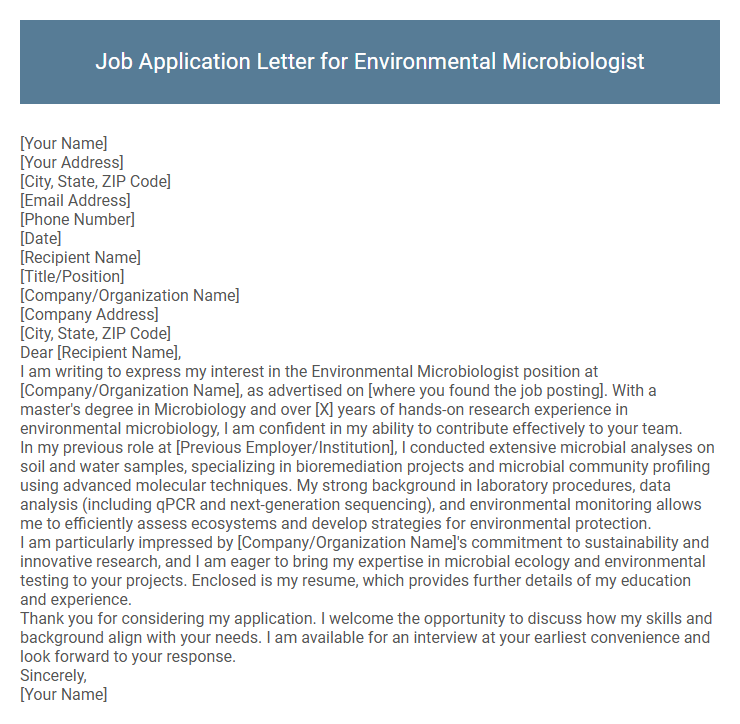
Job Application Letter for Environmental Microbiologist Sample
[Your Address]
[City, State, ZIP Code]
[Email Address]
[Phone Number]
[Date]
[Recipient Name]
[Title/Position]
[Company/Organization Name]
[Company Address]
[City, State, ZIP Code]
Dear [Recipient Name],
I am writing to express my interest in the Environmental Microbiologist position at [Company/Organization Name], as advertised on [where you found the job posting]. With a master's degree in Microbiology and over [X] years of hands-on research experience in environmental microbiology, I am confident in my ability to contribute effectively to your team.
In my previous role at [Previous Employer/Institution], I conducted extensive microbial analyses on soil and water samples, specializing in bioremediation projects and microbial community profiling using advanced molecular techniques. My strong background in laboratory procedures, data analysis (including qPCR and next-generation sequencing), and environmental monitoring allows me to efficiently assess ecosystems and develop strategies for environmental protection.
I am particularly impressed by [Company/Organization Name]'s commitment to sustainability and innovative research, and I am eager to bring my expertise in microbial ecology and environmental testing to your projects. Enclosed is my resume, which provides further details of my education and experience.
Thank you for considering my application. I welcome the opportunity to discuss how my skills and background align with your needs. I am available for an interview at your earliest convenience and look forward to your response.
Sincerely,
[Your Name]
Crafting a compelling job application letter for an Environmental Microbiologist position highlights expertise in analyzing microbial interactions within ecosystems crucial for environmental sustainability. Emphasizing skills in laboratory techniques, data interpretation, and environmental impact assessments demonstrates a candidate's readiness to contribute effectively to ecological research and pollution control projects. Tailoring the letter to showcase relevant experience and passion for advancing environmental health ensures it captures the attention of hiring managers.
What key qualifications should I highlight in my environmental microbiologist job application letter?
Highlight your advanced knowledge in microbiology, environmental science, and molecular biology techniques. Emphasize experience with water and soil sample analysis, microbial ecology, and contamination control. Showcase proficiency in laboratory safety protocols, data analysis software, and regulatory compliance relevant to environmental standards.
How should I structure my cover letter for an environmental microbiologist position?
Structure your cover letter by clearly highlighting your relevant expertise and passion for environmental microbiology. Emphasize your skills and experiences that align with the job requirements to capture the employer's attention.
- Introduction - Briefly introduce yourself and state the position you are applying for, demonstrating your enthusiasm for environmental microbiology.
- Relevant Experience - Summarize your key scientific skills, research projects, and fieldwork that showcase your proficiency in environmental microbiology.
- Closing - Express your desire to contribute to the organization's environmental goals and mention your availability for an interview.
What technical skills are most important to mention in the letter?
Highlight proficiency in microbial identification techniques such as PCR, DNA sequencing, and microbial culturing. Emphasize experience with environmental sampling and data analysis using software like GIS and statistical tools.
Showcase knowledge of water quality testing, biodegradation processes, and contamination control methods. Mention ability to develop and implement laboratory protocols adhering to environmental regulations.
Should I include specific research experience in my application letter?
Including specific research experience in your job application letter for an Environmental Microbiologist position demonstrates your practical expertise and relevance to the role. Highlighting key projects or findings showcases your ability to contribute effectively to the employer's research objectives.
Tailor the details of your research to align with the job description, emphasizing techniques and outcomes that match the employer's needs. This targeted approach increases your chances of standing out as a qualified candidate with specialized knowledge.
How do I demonstrate my teamwork and communication skills in the letter?
In my previous role as an Environmental Microbiologist, I collaborated effectively with interdisciplinary teams to design and implement research projects, ensuring clear and consistent communication of complex data. I actively participated in regular team meetings, presenting findings and integrating feedback to achieve project goals efficiently. My ability to convey technical information to both scientific and non-scientific stakeholders strengthened teamwork and fostered a collaborative work environment.
Is it important to mention publications or presentations in my job application letter?
Including publications or presentations in a job application letter for an Environmental Microbiologist highlights your expertise and contributions to the field. These credentials demonstrate your ability to communicate research findings effectively and your involvement in current scientific discourse. Mentioning them can strengthen your candidacy by showcasing your professional achievements and commitment to advancing environmental microbiology.
How long should my job application letter be for an environmental microbiologist role?
How long should my job application letter be for an environmental microbiologist role? An ideal job application letter for an environmental microbiologist should be concise, typically one page in length. Focus on relevant skills, experience, and enthusiasm to keep the reader engaged.
What keywords should I use to optimize my letter for applicant tracking systems (ATS)?
Use keywords such as "environmental microbiology," "microbial analysis," "bioremediation techniques," "sample collection," and "laboratory safety protocols" to optimize your job application letter for ATS. Include specific skills like "data interpretation," "PCR," "environmental monitoring," and "regulatory compliance" relevant to the role. Highlight qualifications such as "Bachelor's or Master's degree in Microbiology" and "experience with environmental sample testing" to align with job descriptions.
Should I tailor my letter for each environmental microbiologist job posting?
| Aspect | Details |
|---|---|
| Importance of Tailoring | Customizing a job application letter for each environmental microbiologist position increases relevance and appeal to specific job requirements and organizational goals. |
| Key Elements to Tailor | Highlight specific skills, experiences, and achievements that match environmental microbiology techniques, research focus, and project goals listed in the job posting. |
| Benefits | Demonstrates genuine interest, improves chances of passing applicant tracking systems (ATS), and shows alignment with the employer's mission. |
| Common Mistake | Using a generic letter reduces impact and may overlook critical keywords relevant to environmental microbiology roles, such as microbial sampling, contamination analysis, or bioremediation experience. |
| Recommendation | Review each job description carefully, incorporate relevant terminology, and address specific challenges or projects mentioned by the employer. |