
Job Application Letter for Environmental Litigation Specialist Sample
[Your Address]
[City, State, Zip Code]
[Email Address]
[Phone Number]
[Date]
[Recipient Name]
[Title]
[Company/Organization Name]
[Address]
[City, State, Zip Code]
Dear [Recipient Name],
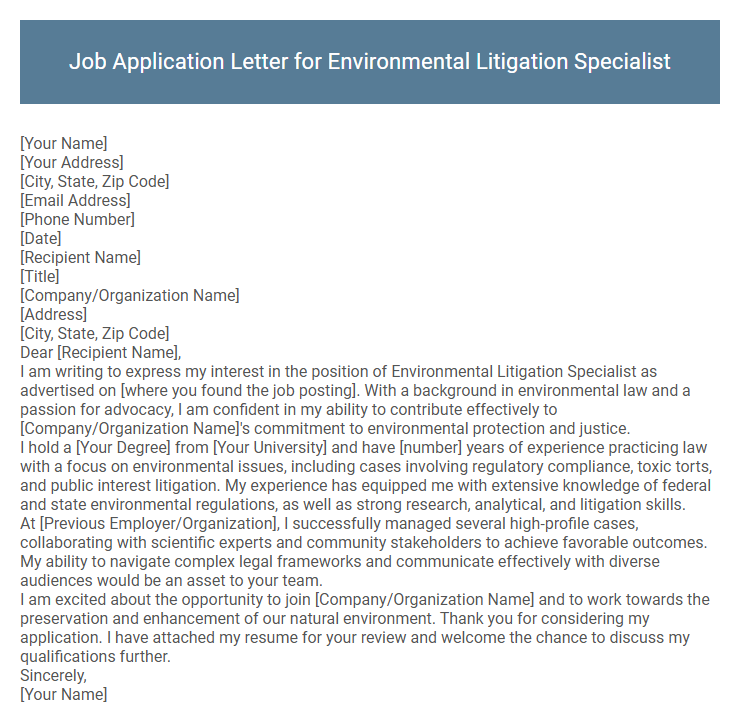
I am writing to express my interest in the position of Environmental Litigation Specialist as advertised on [where you found the job posting]. With a background in environmental law and a passion for advocacy, I am confident in my ability to contribute effectively to [Company/Organization Name]'s commitment to environmental protection and justice.
I hold a [Your Degree] from [Your University] and have [number] years of experience practicing law with a focus on environmental issues, including cases involving regulatory compliance, toxic torts, and public interest litigation. My experience has equipped me with extensive knowledge of federal and state environmental regulations, as well as strong research, analytical, and litigation skills.
At [Previous Employer/Organization], I successfully managed several high-profile cases, collaborating with scientific experts and community stakeholders to achieve favorable outcomes. My ability to navigate complex legal frameworks and communicate effectively with diverse audiences would be an asset to your team.
I am excited about the opportunity to join [Company/Organization Name] and to work towards the preservation and enhancement of our natural environment. Thank you for considering my application. I have attached my resume for your review and welcome the chance to discuss my qualifications further.
Sincerely,
[Your Name]
An Environmental Litigation Specialist brings expertise in navigating complex legal challenges related to environmental regulations and compliance. Drafting a compelling job application letter requires highlighting a strong background in environmental law, proven litigation success, and dedication to sustainability advocacy. Emphasizing analytical skills, attention to detail, and experience working with governmental agencies or environmental organizations strengthens the candidate's position.
What key qualifications should an Environmental Litigation Specialist highlight in a job application letter?
An Environmental Litigation Specialist should highlight expertise in environmental law, including familiarity with regulations such as the Clean Air Act and Clean Water Act. Proven experience in litigation, negotiation, and case management within environmental disputes is essential. Strong analytical skills, attention to detail, and the ability to communicate complex legal concepts clearly are critical qualifications to emphasize.
How do I format a job application letter for an Environmental Litigation Specialist role?
Formatting a job application letter for an Environmental Litigation Specialist requires clarity and professionalism to highlight relevant expertise. Emphasize legal skills and environmental knowledge effectively throughout the letter.
- Header and Contact Information - Include your name, address, phone number, email, and date aligned at the top for professionalism and easy reference.
- Introduction Paragraph - State the job you are applying for and briefly summarize your qualifications and passion for environmental law.
- Body Paragraphs - Detail your litigation experience, relevant cases, environmental regulations knowledge, and key achievements related to environmental protection.
Conclude with a strong closing paragraph expressing enthusiasm for the role and a call to action for an interview or further discussion.
What specific legal experience is important to mention in my letter?
Highlight experience in environmental law, including cases related to pollution control, natural resource management, and regulatory compliance. Emphasize your success in litigation involving government agencies or private corporations on environmental issues.
Mention familiarity with statutes such as the Clean Air Act, Clean Water Act, and Endangered Species Act. Demonstrate your ability to conduct complex legal research, draft compelling briefs, and negotiate settlements in environmental disputes.
How do I demonstrate knowledge of environmental laws and regulations in my application letter?
| Demonstrate Knowledge of Environmental Laws | Highlight specific laws such as the Clean Air Act, Clean Water Act, Endangered Species Act, and relevant state regulations. Mention experience applying these laws in past cases or projects to showcase practical understanding. |
| Showcase Relevant Legal Experience | Detail involvement in environmental litigation, regulatory compliance, or policy advocacy. Include case names or types where you contributed to enforcement or defense under environmental statutes. |
| Use Technical Terminology | Incorporate precise legal and environmental terminology to reflect your deep familiarity, for example, terms like "NEPA compliance," "environmental impact assessments," and "regulatory consultations." |
| Reference Continuing Education | Mention participation in relevant workshops, certifications, or courses related to environmental law, such as CLEs focused on environmental litigation or updates in federal/state regulations. |
| Include Quantifiable Achievements | Provide measurable results from previous roles, such as successful litigation outcomes, reductions in environmental violations through your enforcement efforts, or policy changes influenced by your advocacy. |
Should I include previous case outcomes or litigation successes?
Including previous case outcomes or litigation successes in a job application letter for an Environmental Litigation Specialist can demonstrate your effectiveness and expertise. Highlighting tangible results provides employers with evidence of your ability to achieve impactful legal solutions.
- Relevance - Focus on cases related to environmental law to showcase specialized knowledge and skills.
- Quantifiable Success - Include specific outcomes such as settlements, court rulings, or policy changes to strengthen credibility.
- Brevity - Summarize key achievements concisely to maintain the letter's clarity and impact.
What skills are most valued for Environmental Litigation Specialist positions?
Environmental Litigation Specialists must possess strong legal research and analytical skills to effectively interpret environmental laws and regulations. Expertise in environmental policies, regulatory compliance, and familiarity with litigation procedures is highly valued. Communication skills, including persuasive writing and oral advocacy, are essential for presenting complex environmental cases in court.
How can I tailor my application letter for a government agency versus a private firm?
For a government agency, emphasize your understanding of regulatory frameworks, public policy, and commitment to environmental justice. Highlight experience working on compliance, legislation, and collaboration with government bodies. For a private firm, focus on litigation success, client advocacy, and expertise in navigating corporate environmental liability and risk management.
Is it important to mention teamwork and collaboration abilities in the letter?
Mentioning teamwork and collaboration abilities in a job application letter for an Environmental Litigation Specialist is crucial. These skills demonstrate the candidate's capacity to work effectively with legal teams, environmental experts, and stakeholders.
Environmental litigation often requires coordination among diverse professionals to build strong cases and address complex regulatory issues. Highlighting teamwork skills shows your readiness to contribute to interdisciplinary efforts and achieve shared goals. Employers value specialists who can navigate collaborative environments to enhance case outcomes and drive environmental justice.
What is the ideal length for an Environmental Litigation Specialist job application letter?
What is the ideal length for an Environmental Litigation Specialist job application letter? The ideal length is typically one page, consisting of 3 to 4 concise paragraphs. This allows the candidate to clearly highlight relevant skills, experience, and passion for environmental law without overwhelming the hiring manager.