
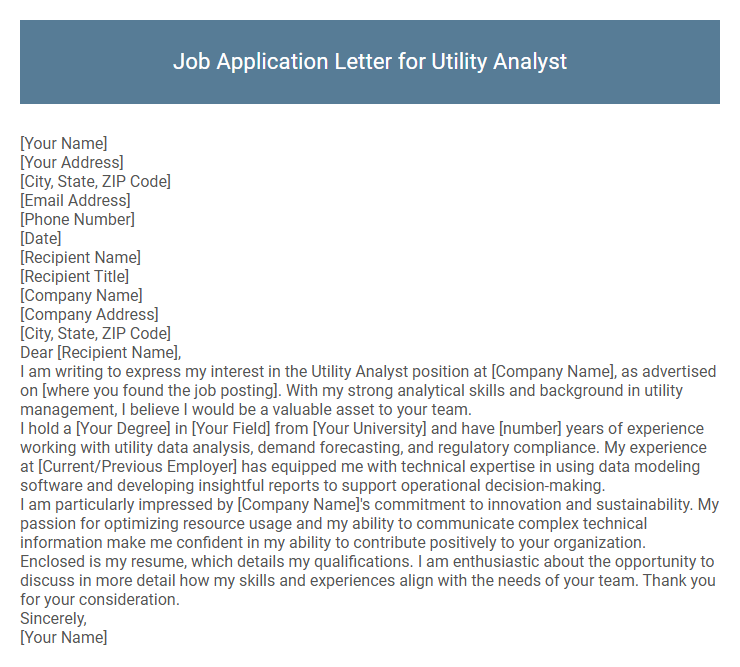
Job Application Letter for Utility Analyst Sample
[Your Address]
[City, State, ZIP Code]
[Email Address]
[Phone Number]
[Date]
[Recipient Name]
[Recipient Title]
[Company Name]
[Company Address]
[City, State, ZIP Code]
Dear [Recipient Name],
I am writing to express my interest in the Utility Analyst position at [Company Name], as advertised on [where you found the job posting]. With my strong analytical skills and background in utility management, I believe I would be a valuable asset to your team.
I hold a [Your Degree] in [Your Field] from [Your University] and have [number] years of experience working with utility data analysis, demand forecasting, and regulatory compliance. My experience at [Current/Previous Employer] has equipped me with technical expertise in using data modeling software and developing insightful reports to support operational decision-making.
I am particularly impressed by [Company Name]'s commitment to innovation and sustainability. My passion for optimizing resource usage and my ability to communicate complex technical information make me confident in my ability to contribute positively to your organization.
Enclosed is my resume, which details my qualifications. I am enthusiastic about the opportunity to discuss in more detail how my skills and experiences align with the needs of your team. Thank you for your consideration.
Sincerely,
[Your Name]
A well-crafted job application letter for a Utility Analyst highlights expertise in data analysis, utility management, and cost optimization. Emphasizing skills in data interpretation, system monitoring, and regulatory compliance demonstrates suitability for the role. Clear communication of relevant experience and problem-solving abilities attracts the attention of hiring managers in the utility sector.
What should I include in a Utility Analyst job application letter?
Include a clear introduction stating the position you are applying for and where you found the job listing. Highlight relevant skills such as data analysis, problem-solving, and experience with utility systems or software tools. Conclude with a confident closing that expresses your enthusiasm for the role and a call to action for an interview opportunity.
How do I highlight relevant skills for a Utility Analyst position?
Highlight analytical skills by emphasizing experience with data interpretation and utility usage optimization. Showcase proficiency in relevant software tools such as Excel, GIS, or energy management systems. Demonstrate problem-solving abilities and knowledge of regulatory compliance within the utility sector.
Should I mention specific software experience in my letter?
Mentioning specific software experience in a job application letter for a Utility Analyst role highlights your technical skills relevant to the position. It demonstrates your ability to efficiently handle data analysis and utility management tasks using industry-standard tools.
- Enhances Relevance - Including software experience aligns your qualifications with the job requirements, making your application more appealing to employers.
- Showcases Technical Proficiency - Detailing software skills such as Excel, SQL, or utility billing systems illustrates your capability to perform essential job functions effectively.
- Improves Competitive Edge - Specific software knowledge can differentiate you from other candidates by proving your readiness to contribute immediately.
How long should my job application letter be?
The job application letter for a Utility Analyst should be concise, ideally between 200 to 300 words. It must clearly highlight relevant skills, experience, and enthusiasm for the role without overwhelming the reader. Keeping it to one page ensures clarity and maintains the employer's attention.
Can I use the same cover letter for multiple Utility Analyst roles?
Using the same cover letter for multiple Utility Analyst roles is possible but requires customization. Tailoring your cover letter to highlight specific skills and experiences relevant to each job increases your chances of success.
Generic cover letters may overlook key job requirements or company values. Personalizing each letter shows genuine interest and aligns your qualifications with the employer's needs, improving your application's impact.
How do I show my analytical skills in the letter?
In the job application letter for a Utility Analyst position, highlight specific instances where you analyzed complex data sets to identify trends and optimize utility performance. Mention your proficiency with analytical tools such as Excel, SQL, or Python that enabled you to draw actionable insights. Emphasize measurable outcomes like cost savings or efficiency improvements driven by your data-driven recommendations.
Should I address the letter to a specific person?
Addressing the job application letter to a specific person shows professionalism and attention to detail. It increases the chances of your letter being noticed by the hiring manager or utility analyst team leader.
- Personalization - Using a specific name demonstrates that you researched the company and are genuinely interested in the role.
- Higher Impact - Letters addressed to a named individual are more likely to be read thoroughly and considered carefully.
- Improves Connection - Directly addressing a person fosters a stronger initial connection and rapport with the hiring team.
What achievements should I mention for a Utility Analyst role?
What achievements should I highlight in a job application letter for a Utility Analyst role? Focus on quantifiable results such as cost savings, efficiency improvements, and data analysis projects that led to operational optimizations. Mention any successful implementation of utility management systems and regulatory compliance achievements.
Is it necessary to mention certifications in the cover letter?
Mentioning certifications in a job application letter for a Utility Analyst position is beneficial if they are relevant to the role. Certifications such as Certified Energy Manager (CEM) or Certified Utility Analyst enhance the applicant's credibility.
Highlighting certifications demonstrates specialized knowledge and commitment to the utility sector. It helps differentiate candidates in a competitive job market. Including certifications related to data analysis, energy management, or regulatory compliance adds value to the application.