
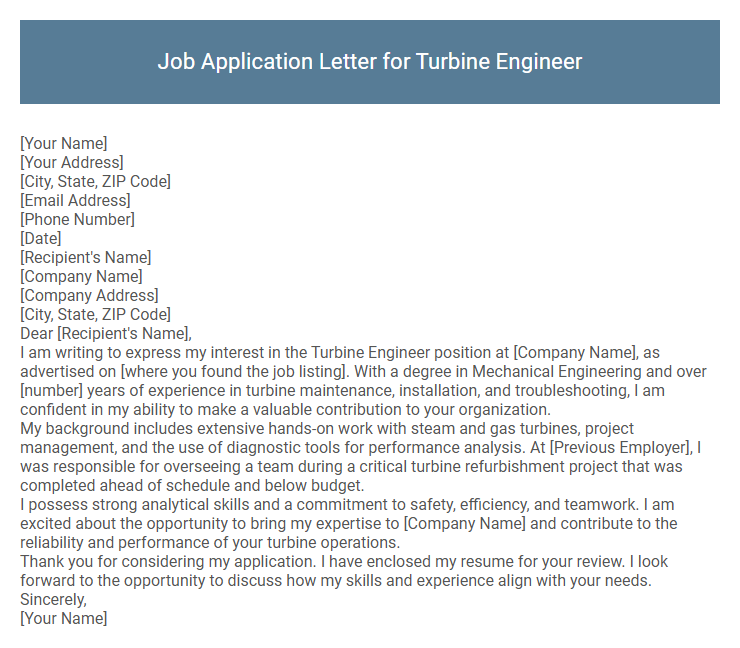
Job Application Letter for Turbine Engineer Sample
[Your Address]
[City, State, ZIP Code]
[Email Address]
[Phone Number]
[Date]
[Recipient's Name]
[Company Name]
[Company Address]
[City, State, ZIP Code]
Dear [Recipient's Name],
I am writing to express my interest in the Turbine Engineer position at [Company Name], as advertised on [where you found the job listing]. With a degree in Mechanical Engineering and over [number] years of experience in turbine maintenance, installation, and troubleshooting, I am confident in my ability to make a valuable contribution to your organization.
My background includes extensive hands-on work with steam and gas turbines, project management, and the use of diagnostic tools for performance analysis. At [Previous Employer], I was responsible for overseeing a team during a critical turbine refurbishment project that was completed ahead of schedule and below budget.
I possess strong analytical skills and a commitment to safety, efficiency, and teamwork. I am excited about the opportunity to bring my expertise to [Company Name] and contribute to the reliability and performance of your turbine operations.
Thank you for considering my application. I have enclosed my resume for your review. I look forward to the opportunity to discuss how my skills and experience align with your needs.
Sincerely,
[Your Name]
Crafting a compelling job application letter for a Turbine Engineer position requires highlighting specialized expertise in turbine design, maintenance, and performance optimization. Demonstrating hands-on experience with gas and steam turbines, along with a strong understanding of thermodynamics and mechanical systems, positions candidates as valuable assets. Emphasizing problem-solving skills and commitment to safety standards ensures alignment with industry expectations and employer requirements.
What key qualifications should a Turbine Engineer highlight in a job application letter?
A Turbine Engineer should highlight expertise in thermodynamics, fluid mechanics, and mechanical design relevant to turbine systems. Proficiency in CAD software and experience with turbine performance analysis and maintenance are essential qualifications. Strong problem-solving skills and knowledge of industry standards such as ASME and ISO ensure the engineer meets safety and efficiency requirements.
How do I address relevant certifications in my application letter?
Highlighting relevant certifications in your turbine engineer job application letter validates your expertise and aligns your skills with industry standards. Clearly mentioning certifications demonstrates your commitment to professional development and technical proficiency.
- Mention Certification Titles - Specify recognized certifications like Certified Senior Turbine Engineer (CSTE) or certifications in thermodynamics and mechanical systems to establish credibility.
- Include Issuing Organizations - Reference authoritative bodies such as the American Society of Mechanical Engineers (ASME) or the Energy Institute to reinforce authenticity.
- Explain Certification Relevance - Briefly illustrate how each certification supports your ability to operate, maintain, or design turbine systems effectively in an engineering environment.
What is the ideal length for a Turbine Engineer cover letter?
The ideal length for a Turbine Engineer cover letter is one page, typically around 250 to 300 words. This length allows for a concise yet comprehensive presentation of relevant skills, experience, and achievements related to turbine engineering. Keeping the letter focused ensures it captures the employer's attention and highlights key qualifications effectively.
Should I mention specific turbine technologies I've worked with?
Mentioning specific turbine technologies in a job application letter for a Turbine Engineer position highlights your technical expertise and relevance to the role. Including details about the types of turbines or systems you've worked with can distinguish you from other candidates.
- Relevance - Showcases your hands-on experience with industry-standard turbine models and technologies.
- Expertise - Demonstrates your technical knowledge and capability to handle specific turbine engineering challenges.
- Customization - Allows tailoring your application to the employer's preferred turbine systems or projects.
Referencing specific turbine technologies enhances your credibility and aligns your skills with the employer's needs.
How do I showcase experience with safety protocols in my application letter?
| Key Focus | How to Showcase |
|---|---|
| Highlight Specific Safety Training | Mention certifications like OSHA, ISO 45001, or any specialized turbine safety courses completed. |
| Detail Safety Implementations | Describe instances where you established or improved safety protocols in turbine operations. |
| Provide Quantifiable Results | Include metrics such as reduction in workplace incidents or improvements in safety audit scores. |
| Show Awareness of Industry Standards | Reference adherence to industry-specific safety regulations, such as ASME or API guidelines. |
| Emphasize Team Safety Leadership | Highlight leadership roles in safety committees or training new team members on safety procedures. |
What achievements are most impressive for a Turbine Engineer role?
Successful design and optimization of turbine efficiency resulting in a 15% increase in power output demonstrates strong technical expertise. Leading a project that reduced turbine downtime by 20% highlights effective problem-solving and maintenance skills.
Experience in implementing advanced diagnostic tools to predict failures ensures improved reliability and safety of turbine operations. Proven ability to collaborate with cross-functional teams to deliver projects on time and within budget supports organizational goals. Recognition for innovation in turbine blade materials reflects commitment to advancing industry standards.
Is it important to tailor my letter to each job posting?
Tailoring your job application letter for a Turbine Engineer position significantly increases your chances of standing out to recruiters. Customizing the letter to highlight relevant skills such as aerodynamic analysis, thermal efficiency, and maintenance experience aligns your profile with the specific job requirements.
Each turbine engineering job posting emphasizes unique technical competencies and project experience, so addressing these explicitly demonstrates your fit for the role. A tailored letter reflects genuine interest and professionalism, making a positive impression on potential employers.
How should I format a Turbine Engineer application letter?
Start your Turbine Engineer application letter with a professional header including your contact information and the employer's details, followed by a clear and concise salutation. Introduce yourself, mention the position you are applying for, and briefly highlight relevant qualifications and experience in turbine technology. Conclude with a polite closing statement, expressing enthusiasm for the role and a call to action for an interview opportunity.
Can I include references in my job application letter?
Including references in a job application letter for a Turbine Engineer position is generally not necessary unless specifically requested by the employer. It is more common to provide references separately during the later stages of the hiring process.
- Employer Preference - Most companies prefer candidates to submit references only upon request to streamline the initial application review.
- Space Optimization - Job application letters should focus on qualifications, skills, and experience relevant to turbine engineering rather than on references.
- Reference Availability - Offering to provide references demonstrates readiness, but listing them upfront may clutter the letter.