
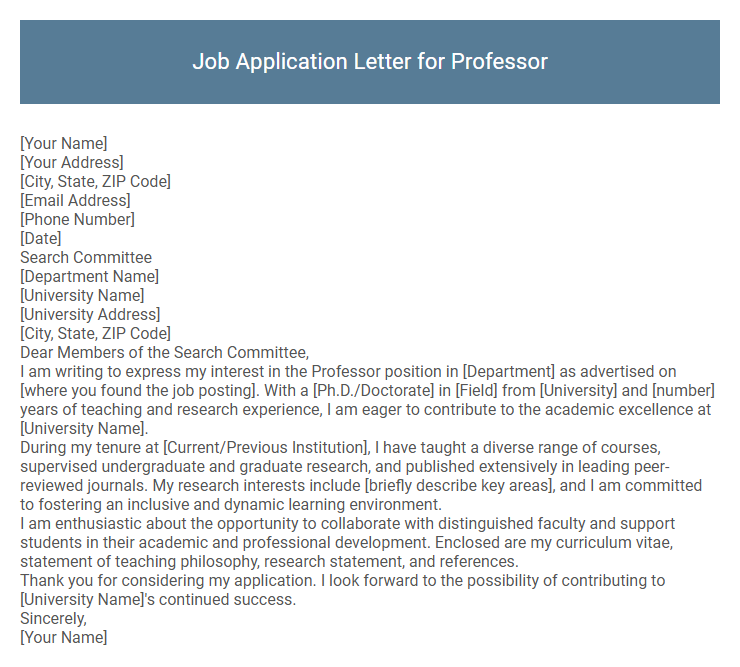
Job Application Letter for Professor Sample
[Your Address]
[City, State, ZIP Code]
[Email Address]
[Phone Number]
[Date]
Search Committee
[Department Name]
[University Name]
[University Address]
[City, State, ZIP Code]
Dear Members of the Search Committee,
I am writing to express my interest in the Professor position in [Department] as advertised on [where you found the job posting]. With a [Ph.D./Doctorate] in [Field] from [University] and [number] years of teaching and research experience, I am eager to contribute to the academic excellence at [University Name].
During my tenure at [Current/Previous Institution], I have taught a diverse range of courses, supervised undergraduate and graduate research, and published extensively in leading peer-reviewed journals. My research interests include [briefly describe key areas], and I am committed to fostering an inclusive and dynamic learning environment.
I am enthusiastic about the opportunity to collaborate with distinguished faculty and support students in their academic and professional development. Enclosed are my curriculum vitae, statement of teaching philosophy, research statement, and references.
Thank you for considering my application. I look forward to the possibility of contributing to [University Name]'s continued success.
Sincerely,
[Your Name]
A well-crafted job application letter for a professor position highlights your academic achievements, teaching experience, and research expertise. Emphasizing your passion for education and your contributions to your field can demonstrate your suitability for the role. Tailoring the letter to the specific institution and department shows your commitment and understanding of their academic culture.
What should I include in a professor job application letter?
Include a strong introduction stating the position you are applying for and where you found the job listing. Highlight your academic credentials, research achievements, teaching experience, and relevant skills tailored to the institution's needs. Conclude with a professional closing expressing enthusiasm for the role and willingness to provide further information or attend an interview.
How do I address the letter to a search committee?
When addressing a job application letter to a search committee for a professor position, use a formal salutation such as "Dear Search Committee Members" or "Dear Members of the Search Committee." This approach demonstrates respect and acknowledges the collective responsibility of the committee.
If the committee chair's name is known, you can address the letter to "Dear Professor [Last Name] and Members of the Search Committee." Avoid using gender-specific titles unless you are certain, and never use generic phrases like "To Whom It May Concern."
What is the ideal length for a professor application letter?
What is the ideal length for a professor application letter? The ideal length for a professor application letter is typically one to two pages. This length allows candidates to clearly present their qualifications, teaching philosophy, and research interests without overwhelming the reader.
Should I mention research interests in the cover letter?
Mentioning research interests in a job application letter for a professor position is highly recommended. It demonstrates alignment with the department's goals and showcases your expertise. Highlighting specific research areas strengthens your candidacy by emphasizing your potential contributions to the institution.
How do I highlight my teaching experience?
Highlight your extensive teaching experience by specifying the courses you have taught and your success in fostering student engagement. Emphasize any innovative teaching methods you have implemented to enhance learning outcomes.
Detail your role in curriculum development and your ability to mentor students in academic and research projects. Mention any awards or recognitions received for teaching excellence. Include examples of positive student feedback or improvements in student performance as evidence of your impact.
Is it important to tailor my letter for each institution?
Tailoring your job application letter for each institution is crucial as it demonstrates genuine interest and knowledge about the university's values and programs. Customized letters highlight how your expertise aligns with the institution's specific needs, increasing your chances of standing out. Generic letters are less effective and may convey a lack of effort or enthusiasm.
Should I include publications and grants in the letter?
| Inclusion of Publications | Highlight key publications relevant to the position to demonstrate expertise and research impact. |
|---|---|
| Inclusion of Grants | Include major grants received to showcase ability to secure research funding and project management skills. |
| Placement in Letter | Briefly mention significant publications and grants in the main body; provide detailed lists in the CV. |
| Purpose | Support qualifications and reflect alignment with the institution's research focus. |
| Balance | Maintain conciseness; avoid exhaustive lists within the letter to keep attention focused. |
How formal should the tone of my application letter be?
The tone of a job application letter for a professor position should be highly formal and professional, reflecting respect for the academic institution and its values. Use precise language, avoid slang, and maintain a polite yet confident demeanor throughout the letter. Emphasize your qualifications and achievements clearly while demonstrating your commitment to academic excellence and research.
Can I discuss collaborative projects in my application letter?
Discussing collaborative projects in a job application letter for a professor position can demonstrate your teamwork skills and research alignment with the department. Highlighting past or potential collaborations may strengthen your candidacy by showcasing your ability to contribute to collective academic goals.
- Relevance to Position - Mention collaborative projects that directly relate to the department's research focus to show fit.
- Highlight Teamwork - Emphasize your role in successful collaborations to illustrate your cooperative and leadership skills.
- Future Potential - Express interest in initiating or continuing collaborative projects to indicate long-term commitment.