
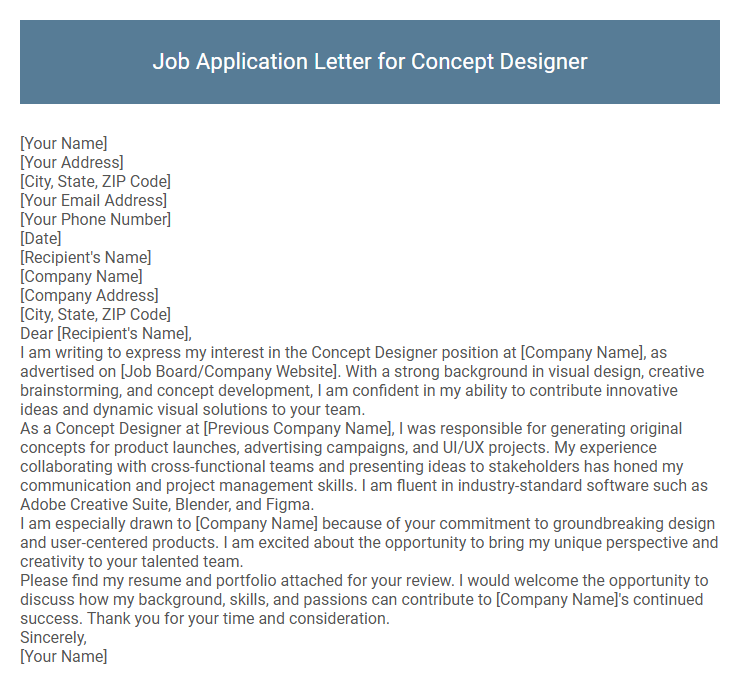
Job Application Letter for Concept Designer Sample
[Your Address]
[City, State, ZIP Code]
[Your Email Address]
[Your Phone Number]
[Date]
[Recipient's Name]
[Company Name]
[Company Address]
[City, State, ZIP Code]
Dear [Recipient's Name],
I am writing to express my interest in the Concept Designer position at [Company Name], as advertised on [Job Board/Company Website]. With a strong background in visual design, creative brainstorming, and concept development, I am confident in my ability to contribute innovative ideas and dynamic visual solutions to your team.
As a Concept Designer at [Previous Company Name], I was responsible for generating original concepts for product launches, advertising campaigns, and UI/UX projects. My experience collaborating with cross-functional teams and presenting ideas to stakeholders has honed my communication and project management skills. I am fluent in industry-standard software such as Adobe Creative Suite, Blender, and Figma.
I am especially drawn to [Company Name] because of your commitment to groundbreaking design and user-centered products. I am excited about the opportunity to bring my unique perspective and creativity to your talented team.
Please find my resume and portfolio attached for your review. I would welcome the opportunity to discuss how my background, skills, and passions can contribute to [Company Name]'s continued success. Thank you for your time and consideration.
Sincerely,
[Your Name]
A job application letter for a Concept Designer highlights creative skills and innovative thinking essential for developing compelling visual concepts. It emphasizes experience in ideation, graphic design, and collaborative project execution to meet client needs. Showcasing a strong portfolio and passion for design innovation establishes the candidate's suitability for the role.
What should I include in a Concept Designer job application letter?
Include a strong introduction highlighting your experience and passion for concept design. Emphasize key skills such as creativity, proficiency in design software, and ability to translate ideas into visual concepts. Conclude with a confident statement expressing eagerness to contribute to the company's projects and team.
How do I highlight my design skills in the letter?
Emphasize your proficiency with design software such as Adobe Creative Suite, Sketch, or Figma, highlighting projects where your creativity solved complex design challenges. Mention your ability to translate abstract ideas into visually compelling concepts that align with client goals.
Include specific examples of past work where your innovative design improved user experience or increased engagement. Highlight collaboration skills with cross-functional teams to demonstrate your adaptability and effective communication in the design process.
What portfolio links should I mention?
Mention portfolio links that showcase your best concept design work, including character designs, environment art, and visual development projects. Include links to your personal website, ArtStation, or Behance profiles for easy access to diverse examples. Highlight any collaborative projects or client work that demonstrate your versatility and creativity in concept design.
How can I show industry-specific experience?
How can I demonstrate industry-specific experience in a job application letter for a Concept Designer position? Highlight your previous projects that align with the company's niche, emphasizing tools and techniques used in concept design. Mention collaborations with clients or teams in relevant industries to showcase practical expertise and adaptability.
Should I mention software proficiency?
Mentioning software proficiency in a Job Application Letter for a Concept Designer is essential to demonstrate technical skills relevant to the role. Highlighting expertise in industry-standard tools like Adobe Photoshop, Illustrator, and 3D modeling software can strengthen your application.
Specifying software knowledge helps employers assess your ability to contribute effectively to projects. Tailor your software skills to match the job description for maximum impact.
How do I address the letter if I don't know the hiring manager's name?
If the hiring manager's name is unknown, address the letter with a professional and neutral greeting such as "Dear Hiring Manager" or "Dear Recruitment Team." This maintains respect and formality in your job application letter.
Ensure the greeting matches the company's culture by researching the organization's website or job posting. Avoid generic phrases like "To Whom It May Concern" as they can seem outdated. Use clear and direct language to capture attention and demonstrate professionalism.
What tone is appropriate for a Concept Designer application letter?
The tone of a job application letter for a Concept Designer should be creative yet professional, reflecting both artistic skill and business acumen. It must convey enthusiasm for design challenges while demonstrating clear communication abilities.
- Confident - Showcases your expertise and unique design perspective to stand out.
- Innovative - Highlights your ability to think outside the box and develop fresh concepts.
- Collaborative - Emphasizes teamwork skills critical for working with clients and developers.
A balanced, engaging tone tailored to the design industry increases your chances of making a strong impression.
How long should the letter be?
A job application letter for a Concept Designer should be concise, ideally between 250 to 350 words. This length allows you to highlight key skills, relevant experience, and your passion for design without overwhelming the reader. Keep it focused on your creative abilities and professional achievements to make a strong impression.
Is it important to customize the letter for each job?
Customizing a job application letter for a Concept Designer role is crucial to highlight relevant skills and align with the company's creative vision. Tailored letters demonstrate genuine interest and understanding of the job requirements, increasing the chances of standing out. Employers value personalized applications as they reflect dedication and suitability for the specific design challenges.