
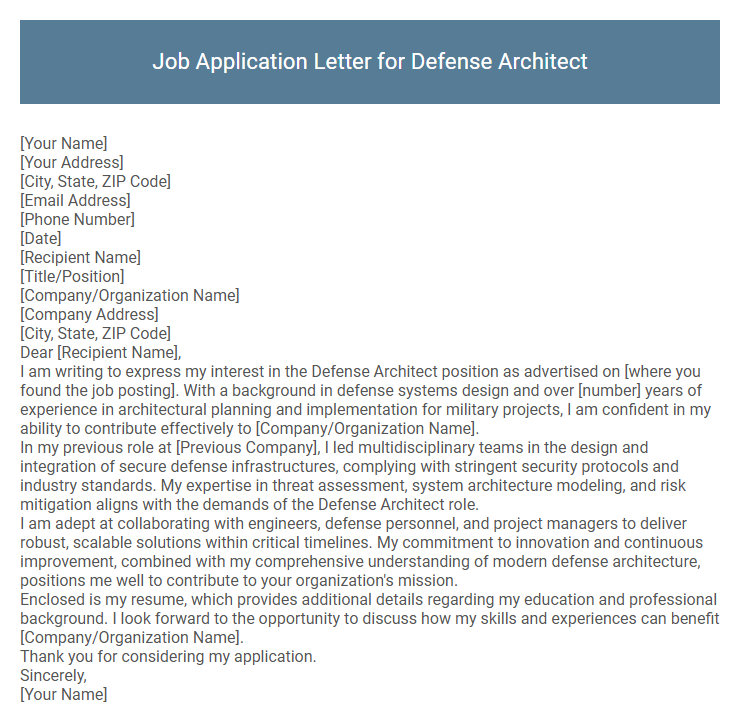
Job Application Letter for Defense Architect Sample
[Your Address]
[City, State, ZIP Code]
[Email Address]
[Phone Number]
[Date]
[Recipient Name]
[Title/Position]
[Company/Organization Name]
[Company Address]
[City, State, ZIP Code]
Dear [Recipient Name],
I am writing to express my interest in the Defense Architect position as advertised on [where you found the job posting]. With a background in defense systems design and over [number] years of experience in architectural planning and implementation for military projects, I am confident in my ability to contribute effectively to [Company/Organization Name].
In my previous role at [Previous Company], I led multidisciplinary teams in the design and integration of secure defense infrastructures, complying with stringent security protocols and industry standards. My expertise in threat assessment, system architecture modeling, and risk mitigation aligns with the demands of the Defense Architect role.
I am adept at collaborating with engineers, defense personnel, and project managers to deliver robust, scalable solutions within critical timelines. My commitment to innovation and continuous improvement, combined with my comprehensive understanding of modern defense architecture, positions me well to contribute to your organization's mission.
Enclosed is my resume, which provides additional details regarding my education and professional background. I look forward to the opportunity to discuss how my skills and experiences can benefit [Company/Organization Name].
Thank you for considering my application.
Sincerely,
[Your Name]
Crafting a compelling job application letter for a Defense Architect position requires highlighting expertise in security infrastructure design and strategic defense solutions. Emphasizing a deep understanding of threat assessment, risk management, and innovative architectural frameworks can demonstrate the candidate's ability to protect critical assets. Showcasing relevant experience in military or government projects establishes credibility and aligns with the stringent requirements of defense-related roles.
What key qualifications should a Defense Architect highlight in a job application letter?
A Defense Architect should highlight expertise in cybersecurity frameworks, risk assessment, and threat mitigation strategies. Proficiency in designing secure network architectures and familiarity with defense industry standards are crucial. Demonstrating experience with advanced encryption technologies and incident response planning strengthens the application.
How should a Defense Architect address security clearance requirements in the letter?
A Defense Architect should explicitly mention their current security clearance level and its expiration date to assure the employer of their eligibility. Highlighting any relevant experience handling classified information reinforces trustworthiness and compliance with security protocols.
The letter should also express the candidate's understanding of the importance of maintaining clearance and willingness to undergo any necessary background checks or reinvestigations. Demonstrating familiarity with government standards showcases preparedness and professionalism in sensitive environments.
What technical skills are most important to mention for Defense Architecture roles?
Technical skills essential for Defense Architect roles include expertise in cybersecurity frameworks, threat modeling, and secure systems design. Proficiency in network security protocols, cryptographic techniques, and compliance standards such as NIST and DoD RMF is critical.
Knowledge of cloud security architectures, including AWS GovCloud or Azure Government, is highly valued. Experience with defense-grade encryption methods and security information and event management (SIEM) tools enhances a candidate's profile. Familiarity with military communication standards and secure software development life cycle (SDLC) processes strengthens a Defense Architect's effectiveness.
Should I include specific defense project experience in my application letter?
Including specific defense project experience in your job application letter for a Defense Architect position is highly recommended. Highlighting relevant projects demonstrates your expertise and alignment with the role's requirements.
- Relevance - Showcasing defense-specific projects ensures your skills directly match the job description and industry demands.
- Credibility - Detailed project experience builds trust with hiring managers by evidencing your practical knowledge in defense architecture.
- Competitive Advantage - Specific examples of past successful defense projects distinguish you from other candidates and increase your chances of selection.
How do I reference classified or confidential work in a job application letter?
When referencing classified or confidential work in a job application letter for a Defense Architect position, emphasize your security clearance and general responsibilities without disclosing sensitive specifics.
Highlight your ability to handle classified information responsibly and your experience working within secure environments to demonstrate trustworthiness and professionalism.
- Mention Security Clearance - Specify your level of clearance, such as Top Secret or TS/SCI, to establish your eligibility for handling sensitive projects.
- Generalize Project Descriptions - Use broad terms like "classified defense infrastructure" or "secure military systems" to describe your work without revealing details.
- Focus on Skills and Impact - Emphasize your architectural design expertise, problem-solving abilities, and contributions to national security within the confines of confidentiality.
What is the ideal length for a Defense Architect job application letter?
The ideal length for a Defense Architect job application letter is typically one page, containing 3 to 4 concise paragraphs. This length allows candidates to clearly highlight relevant experience, technical skills, and security expertise without overwhelming the reader. Keeping the letter focused ensures hiring managers quickly assess the applicant's suitability for the Defense Architect role.
How should I address the hiring manager in my application letter?
When addressing the hiring manager in your job application letter for a Defense Architect position, use a professional and respectful salutation. Tailoring the greeting to the specific person or role demonstrates attention to detail and professionalism.
- Use the hiring manager's name - Search the job posting or company website to find the name for a personalized greeting.
- Employ formal titles - Use "Mr.," "Ms.," or professional titles such as "Dr." if applicable to show respect.
- Opt for a general greeting if unknown - Use "Dear Hiring Manager" or "Dear Recruitment Team" if the name is unavailable.
Addressing the hiring manager correctly sets a positive tone for your Defense Architect application letter.
Is it necessary to mention certifications such as CISSP or CISM in the letter?
Including certifications like CISSP or CISM in a job application letter for a Defense Architect highlights specialized skills and adherence to industry security standards. These credentials validate expertise in cybersecurity and risk management, which are critical in defense architecture roles. Mentioning relevant certifications strengthens the applicant's professional profile and improves the chances of advancing in the hiring process.
Can I use bullet points to highlight achievements in my application letter?
| Aspect | Details |
|---|---|
| Use of Bullet Points | Bullet points effectively highlight key achievements and technical skills in a Defense Architect application letter, improving readability. |
| Recommended Content | Include specific project outcomes, security certifications, and systems architecture expertise relevant to defense technology. |
| Formatting Tips | Keep bullet points concise, focused on measurable results, such as reduced system vulnerabilities or enhanced network security protocols. |
| Impact on Screening | Bullet points help hiring managers quickly identify important qualifications and achievements, strengthening the application. |
| Best Practices | Limit bullet points to 3-5 key achievements, integrate them after a strong introductory paragraph summarizing your defense expertise. |