
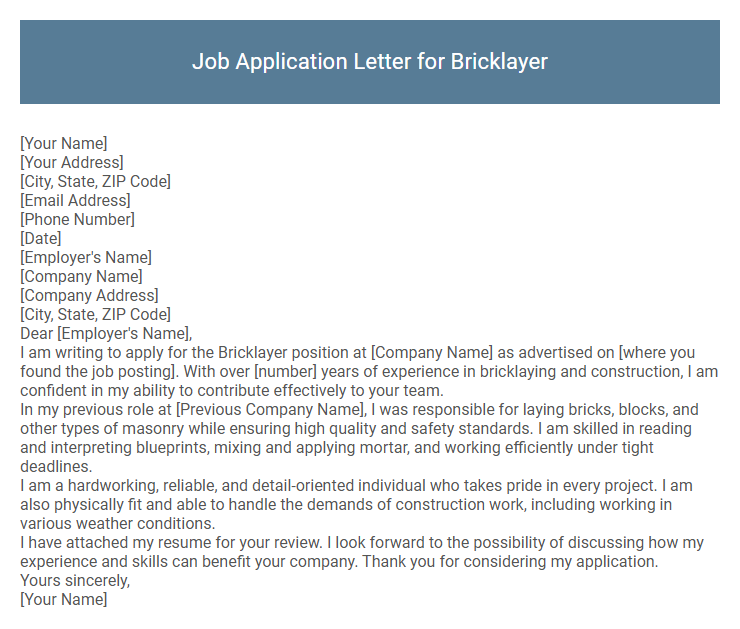
Job Application Letter for Bricklayer Sample
[Your Address]
[City, State, ZIP Code]
[Email Address]
[Phone Number]
[Date]
[Employer's Name]
[Company Name]
[Company Address]
[City, State, ZIP Code]
Dear [Employer's Name],
I am writing to apply for the Bricklayer position at [Company Name] as advertised on [where you found the job posting]. With over [number] years of experience in bricklaying and construction, I am confident in my ability to contribute effectively to your team.
In my previous role at [Previous Company Name], I was responsible for laying bricks, blocks, and other types of masonry while ensuring high quality and safety standards. I am skilled in reading and interpreting blueprints, mixing and applying mortar, and working efficiently under tight deadlines.
I am a hardworking, reliable, and detail-oriented individual who takes pride in every project. I am also physically fit and able to handle the demands of construction work, including working in various weather conditions.
I have attached my resume for your review. I look forward to the possibility of discussing how my experience and skills can benefit your company. Thank you for considering my application.
Yours sincerely,
[Your Name]
A job application letter for a bricklayer highlights relevant skills such as masonry techniques, attention to detail, and physical stamina. Emphasizing experience with various construction materials and safety protocols demonstrates reliability and professionalism. Clear communication of a strong work ethic and commitment to quality craftsmanship can significantly improve hiring prospects.
What should I include in a bricklayer job application letter?
Include your relevant experience and skills in bricklaying, such as knowledge of materials and construction techniques. Highlight your ability to read blueprints and follow safety regulations. Emphasize your strong work ethic and teamwork skills to demonstrate reliability and collaboration on job sites.
How do I highlight my bricklaying experience in the letter?
Emphasize your years of hands-on experience in bricklaying, detailing specific projects where you successfully applied your skills. Highlight proficiency with various materials, tools, and techniques that demonstrate your expertise and reliability. Mention any certifications or safety training that enhance your qualifications and commitment to quality workmanship.
Do I need to mention certifications in my application letter?
Mentioning certifications in your job application letter for a bricklayer position demonstrates your qualifications and commitment to the trade. Relevant certifications validate your skills and can set you apart from other candidates.
Highlighting certifications such as OSHA safety training or masonry-specific qualifications increases your credibility. Employers seek certified bricklayers to ensure safety and quality workmanship on their projects.
How long should my bricklayer job application letter be?
Your bricklayer job application letter should be concise, ideally between 250 to 400 words. This length allows you to highlight your skills and experience without overwhelming the reader.
Focus on relevant qualifications, key projects, and your passion for bricklaying. Keeping it brief ensures hiring managers can quickly assess your suitability for the role.
Should I include references in my application letter?
Including references in a bricklayer job application letter is generally optional unless specifically requested by the employer. Focus on highlighting your skills and experience first, and mention that references are available upon request.
- References upon request - Employers often prefer candidates to provide references only after the initial screening.
- Space efficiency - Including references in the letter can reduce space for showcasing your qualifications and experience.
- Professionalism - Offering references when asked demonstrates preparedness and respects the employer's application process.
How do I address the employer in the letter?
Address the employer in a job application letter for a bricklayer by using a formal and respectful salutation. Ensure the greeting is personalized whenever possible to create a strong first impression.
- Use the employer's name - Personalize the letter by addressing the hiring manager or employer directly using their full name or title.
- Include proper titles - Use titles such as Mr., Ms., or Dr., followed by the last name to show professionalism and respect.
- Default to a generic greeting if unknown - Use "Dear Hiring Manager" or "Dear Recruitment Team" when the employer's name is not available.
Correctly addressing the employer sets a professional tone and increases the chances of your application being noticed.
What skills are important to mention for a bricklayer position?
Important skills for a bricklayer position include proficiency in laying bricks, blocks, and stone with precision and efficiency. Knowledge of reading blueprints and measuring tools is essential for accurate construction work.
Physical strength and stamina are crucial to handle heavy materials and work in various weather conditions. Attention to detail ensures the structural integrity and aesthetic quality of the masonry work. Experience with mortar mixing and applying safety standards also enhances job performance.
Can I use a template for my bricklayer job application letter?
Can I use a template for my bricklayer job application letter?
Using a template can help structure your bricklayer job application letter professionally. Customize the template with specific skills and experiences relevant to the bricklaying trade for better results.
Should I mention my ability to read blueprints in the letter?
Mentioning your ability to read blueprints in a job application letter for a bricklayer position is essential. It demonstrates technical skills crucial for precise construction work.
- Blueprint Reading Skills - Highlighting this ability shows you understand construction plans and specifications.
- Enhanced Job Suitability - Employers value candidates who can interpret blueprints accurately to ensure project accuracy.
- Competitive Advantage - Including this skill sets you apart from applicants lacking technical expertise.