
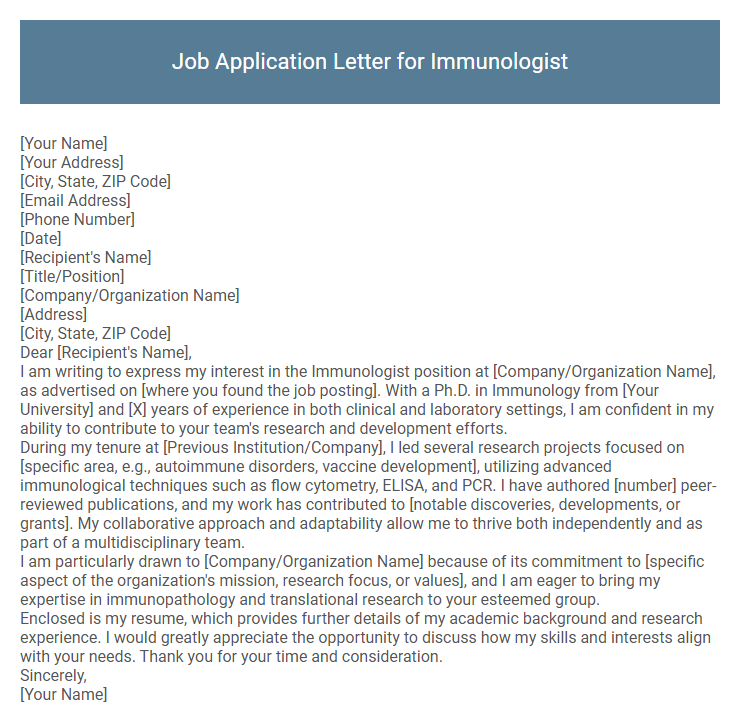
Job Application Letter for Immunologist Sample
[Your Address]
[City, State, ZIP Code]
[Email Address]
[Phone Number]
[Date]
[Recipient's Name]
[Title/Position]
[Company/Organization Name]
[Address]
[City, State, ZIP Code]
Dear [Recipient's Name],
I am writing to express my interest in the Immunologist position at [Company/Organization Name], as advertised on [where you found the job posting]. With a Ph.D. in Immunology from [Your University] and [X] years of experience in both clinical and laboratory settings, I am confident in my ability to contribute to your team's research and development efforts.
During my tenure at [Previous Institution/Company], I led several research projects focused on [specific area, e.g., autoimmune disorders, vaccine development], utilizing advanced immunological techniques such as flow cytometry, ELISA, and PCR. I have authored [number] peer-reviewed publications, and my work has contributed to [notable discoveries, developments, or grants]. My collaborative approach and adaptability allow me to thrive both independently and as part of a multidisciplinary team.
I am particularly drawn to [Company/Organization Name] because of its commitment to [specific aspect of the organization's mission, research focus, or values], and I am eager to bring my expertise in immunopathology and translational research to your esteemed group.
Enclosed is my resume, which provides further details of my academic background and research experience. I would greatly appreciate the opportunity to discuss how my skills and interests align with your needs. Thank you for your time and consideration.
Sincerely,
[Your Name]
A well-crafted job application letter for an immunologist highlights expertise in immune system research and clinical practice, emphasizing a strong background in immunology, laboratory techniques, and patient care. Demonstrating a commitment to advancing immunological knowledge and improving health outcomes through innovative approaches is essential. Clear communication of relevant experience and passion for the role ensures a compelling introduction to prospective employers.
What should I include in a job application letter for an immunologist position?
Include your relevant academic qualifications and specialized training in immunology to demonstrate your expertise. Highlight your practical experience with immunological techniques, research projects, or clinical diagnostics that match the job requirements. Emphasize your ability to work collaboratively in multidisciplinary teams and your commitment to advancing immunological knowledge and patient care.
How do I highlight my immunology experience in the letter?
Emphasize your hands-on experience with immunological techniques such as flow cytometry, ELISA, and immunohistochemistry in your job application letter. Highlight specific research projects or clinical cases where your expertise contributed to advances in understanding immune responses or developing immunotherapies. Showcase measurable outcomes like publications, presentations, or successful collaborations that demonstrate your impact in the field of immunology.
Do I need to mention specific lab skills in my application letter?
Do I need to mention specific lab skills in my job application letter for an Immunologist position? Highlighting relevant laboratory skills such as flow cytometry, ELISA, and cell culture demonstrates your technical expertise and suitability for the role. Tailoring these skills to the job description enhances your application's impact and relevance.
Should I address the letter to a specific person or department?
Addressing a job application letter for an Immunologist to a specific person demonstrates professionalism and attention to detail. It enhances the chance of your letter being read by the right decision-maker.
If the job posting includes a contact name, use it to personalize your letter. When no specific name is provided, address the letter to the hiring committee or the Human Resources department. Researching the organization's website or calling their office can often help identify the appropriate recipient.
What is the ideal length for an immunologist job application letter?
The ideal length for an immunologist job application letter is one page, typically between 300 to 400 words. This length allows for a concise yet comprehensive presentation of qualifications and experience relevant to immunology.
Keeping the letter focused ensures clarity and professionalism, highlighting key achievements and skills without overwhelming the reader. An organized, succinct letter increases the chances of making a strong impression on hiring managers in the immunology field.
How can I showcase my research achievements in the letter?
| Strategy | Description |
|---|---|
| Highlight Published Papers | Mention peer-reviewed journals, impact factors, and citation counts of your immunology research papers. |
| Describe Key Projects | Summarize major research projects, objectives, and outcomes relevant to immunology advancements. |
| Quantify Achievements | Use specific metrics like number of experiments, clinical trials, or immune-response assays conducted. |
| Explain Research Impact | Illustrate how your work influenced immunology practices, vaccine development, or treatment protocols. |
| Include Awards and Grants | List relevant research grants, fellowships, or awards validating your expertise and contributions. |
Is it important to mention my publications or presentations?
Mentioning your publications or presentations in a job application letter for an immunologist position demonstrates your expertise and contributions to the field. It highlights your research skills and commitment to advancing immunology.
Incorporating key publications or notable presentations provides evidence of your ability to communicate scientific findings effectively. This can set you apart from other candidates and strengthen your application.
How do I tailor my letter for a clinical vs. research immunologist role?
Tailoring a job application letter for a clinical immunologist emphasizes patient care, diagnostic expertise, and collaboration with healthcare teams. For a research immunologist, focus on experimental skills, data analysis, and contributions to scientific knowledge.
- Clinical Immunologist - Highlight experience in diagnosing and managing immune-related diseases.
- Clinical Immunologist - Emphasize proficiency in interpreting laboratory results and patient interactions.
- Research Immunologist - Showcase accomplishments in designing experiments and publishing scientific papers.
- Research Immunologist - Detail specific methodologies used and innovations contributed to immunology research.
Customize language and examples to reflect either patient-centered clinical work or hypothesis-driven research endeavors.
Should I include references in my application letter or separately?
Including references directly in your immunologist job application letter is generally not recommended. References should be provided separately unless specifically requested by the employer.
- Focus on qualifications - The application letter should highlight your skills, experience, and suitability for the immunologist role without distractions from reference details.
- Professional presentation - Separate reference documentation maintains a clean and professional application, allowing hiring managers to focus on your credentials first.
- Follow instructions - If the job posting requests references to be included in the letter, then follow those guidelines precisely to meet employer expectations.