
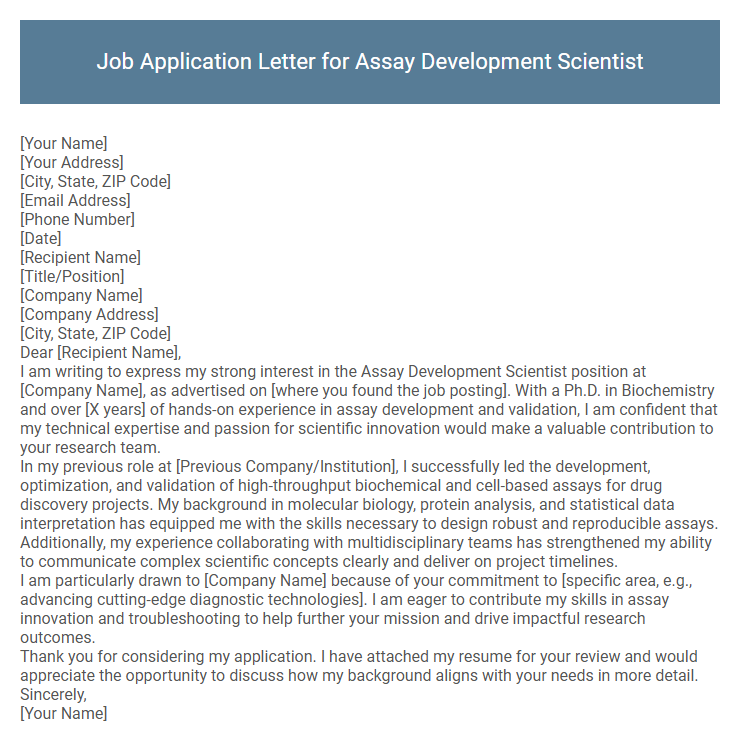
Job Application Letter for Assay Development Scientist Sample
[Your Address]
[City, State, ZIP Code]
[Email Address]
[Phone Number]
[Date]
[Recipient Name]
[Title/Position]
[Company Name]
[Company Address]
[City, State, ZIP Code]
Dear [Recipient Name],
I am writing to express my strong interest in the Assay Development Scientist position at [Company Name], as advertised on [where you found the job posting]. With a Ph.D. in Biochemistry and over [X years] of hands-on experience in assay development and validation, I am confident that my technical expertise and passion for scientific innovation would make a valuable contribution to your research team.
In my previous role at [Previous Company/Institution], I successfully led the development, optimization, and validation of high-throughput biochemical and cell-based assays for drug discovery projects. My background in molecular biology, protein analysis, and statistical data interpretation has equipped me with the skills necessary to design robust and reproducible assays. Additionally, my experience collaborating with multidisciplinary teams has strengthened my ability to communicate complex scientific concepts clearly and deliver on project timelines.
I am particularly drawn to [Company Name] because of your commitment to [specific area, e.g., advancing cutting-edge diagnostic technologies]. I am eager to contribute my skills in assay innovation and troubleshooting to help further your mission and drive impactful research outcomes.
Thank you for considering my application. I have attached my resume for your review and would appreciate the opportunity to discuss how my background aligns with your needs in more detail.
Sincerely,
[Your Name]
Submitting a well-crafted job application letter for an Assay Development Scientist position highlights your expertise in designing and optimizing biochemical assays critical for drug discovery and diagnostics. Emphasizing your experience with diverse assay platforms, data analysis skills, and proficiency in laboratory techniques demonstrates your capability to contribute effectively to cutting-edge research projects. Tailoring your letter to reflect a passion for innovation and accuracy underscores your commitment to advancing scientific outcomes.
What key qualifications should I highlight in my job application letter for an Assay Development Scientist position?
Highlight your expertise in designing, optimizing, and validating bioanalytical assays using cutting-edge techniques such as ELISA, PCR, and cell-based assays. Emphasize your experience with assay troubleshooting, data analysis, and proficiency in automation and high-throughput screening technologies. Showcase strong knowledge of regulatory guidelines, excellent problem-solving skills, and collaboration within cross-functional teams to accelerate drug discovery and development.
How should I structure my job application letter for an Assay Development Scientist role?
Begin your job application letter by introducing yourself and stating the position of Assay Development Scientist you are applying for, highlighting your relevant experience in assay design and validation. Emphasize your technical skills, such as proficiency in ELISA, PCR, and cell-based assays, and your ability to optimize assay performance for drug discovery or diagnostics. Conclude by expressing enthusiasm for the role and how your expertise aligns with the company's research goals, inviting further discussion in an interview.
What relevant technical skills are employers looking for in Assay Development Scientists?
| Technical Skills | Description |
|---|---|
| Assay Design and Optimization | Expertise in developing and refining biochemical and cell-based assays for drug discovery and diagnostics. |
| Molecular Biology Techniques | Proficiency in PCR, ELISA, Western blotting, and other molecular assays for target validation and biomarker analysis. |
| Data Analysis and Interpretation | Strong skills in statistical analysis, curve fitting, and software tools like GraphPad Prism and MATLAB. |
| Automation and High-Throughput Screening (HTS) | Experience with robotic systems and plate readers to increase assay throughput and reproducibility. |
| Regulatory Compliance and Documentation | Knowledge of GLP standards, assay validation protocols, and meticulous record-keeping for audit readiness. |
Should I mention specific assay platforms or technologies in my application letter?
Mentioning specific assay platforms or technologies in your job application letter for an Assay Development Scientist position highlights your relevant expertise and aligns your skills with the employer's needs. It demonstrates your familiarity with techniques critical to the role, such as ELISA, flow cytometry, or mass spectrometry.
Focus on platforms that match the job description to showcase your technical proficiency and impact in previous projects. Avoid listing generic skills; instead, emphasize how your experience with these technologies contributed to successful assay development and validation.
How can I demonstrate problem-solving abilities in my job application letter?
Highlight specific examples where you identified challenges in assay development and successfully implemented innovative solutions. Emphasize your analytical skills and ability to troubleshoot complex problems in experimental setups.
Describe instances of optimizing protocols to improve accuracy or efficiency in assays. Showcase your proactive approach in collaborating with cross-functional teams to overcome technical obstacles.
What professional achievements should I include for an Assay Development Scientist role?
Highlight key professional achievements that demonstrate your expertise in assay development and validation. Emphasize measurable impacts on research projects and product development within the life sciences or biotechnology sectors.
- Successful assay optimization - Improved assay sensitivity and specificity, reducing variability by 30% across multiple projects.
- High-throughput screening implementation - Developed and validated robust high-throughput assays that increased sample processing capacity by 50%.
- Cross-functional collaboration - Led teamwork with biologists and chemists to deliver assays that supported regulatory submissions and accelerated drug discovery timelines.
Include quantifiable results to clearly convey your contributions and technical proficiency in assay development.
Is it important to address my experience with regulatory compliance in my cover letter?
Addressing your experience with regulatory compliance in your cover letter for an Assay Development Scientist position is crucial. It demonstrates your ability to meet industry standards and ensures the reliability of assay results.
- Regulatory Knowledge - Highlighting compliance experience shows your familiarity with guidelines such as FDA and ISO standards relevant to assay development.
- Quality Assurance - Emphasizing your role in maintaining regulatory compliance reflects your commitment to quality and reproducibility in scientific work.
- Competitive Edge - Employers prioritize candidates who ensure assays meet legal and safety requirements, making your compliance experience a key asset.
How do I tailor my job application letter for entry-level vs. experienced Assay Development Scientist positions?
For entry-level Assay Development Scientist positions, emphasize relevant academic projects, internships, and foundational laboratory skills that demonstrate your potential and eagerness to grow. Highlight your familiarity with assay development techniques, analytical instruments, and attention to detail, supported by your education and any hands-on experience. Express a strong willingness to learn and adapt within a collaborative research environment.
For experienced Assay Development Scientist roles, focus on specific accomplishments, such as successfully developed assays, process optimizations, and contributions to published research or validated protocols. Showcase proficiency in various assay platforms, problem-solving skills, and leadership or mentorship roles that reflect your expertise. Quantify achievements where possible, emphasizing your impact on product development, quality improvements, or project timelines.
What is the ideal length for a job application letter for this role?
The ideal length for a job application letter for an Assay Development Scientist role is concise, typically one page. This length ensures clear communication of qualifications without overwhelming the recruiter.
- Conciseness - Limits the letter to one page to highlight relevant skills efficiently.
- Relevance - Focuses on key achievements in assay development to maintain reader engagement.
- Clarity - Uses precise language to convey expertise and suitability for the role.