
Job Application Letter for Design Engineer Sample
[Your Address]
[City, State, Zip Code]
[Email Address]
[Phone Number]
[Date]
[Recipient's Name]
[Company Name]
[Company Address]
[City, State, Zip Code]
Dear [Recipient's Name],
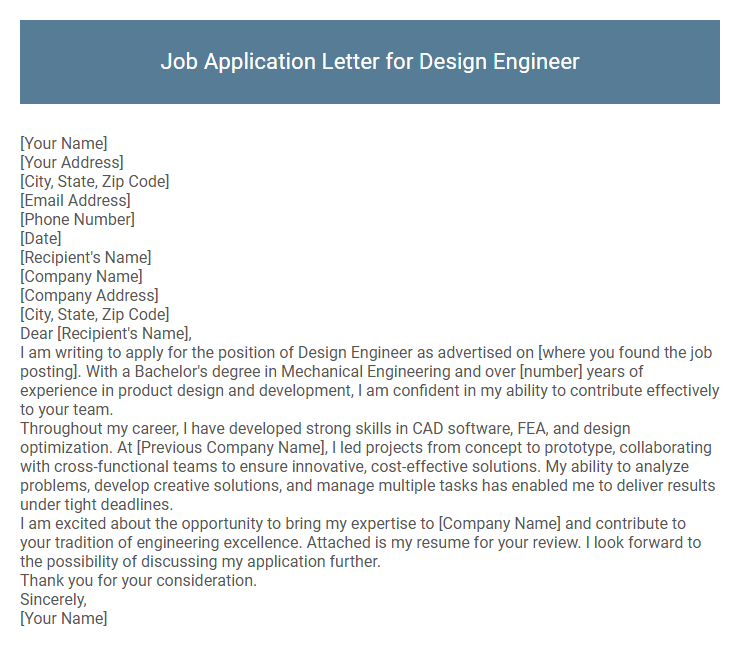
I am writing to apply for the position of Design Engineer as advertised on [where you found the job posting]. With a Bachelor's degree in Mechanical Engineering and over [number] years of experience in product design and development, I am confident in my ability to contribute effectively to your team.
Throughout my career, I have developed strong skills in CAD software, FEA, and design optimization. At [Previous Company Name], I led projects from concept to prototype, collaborating with cross-functional teams to ensure innovative, cost-effective solutions. My ability to analyze problems, develop creative solutions, and manage multiple tasks has enabled me to deliver results under tight deadlines.
I am excited about the opportunity to bring my expertise to [Company Name] and contribute to your tradition of engineering excellence. Attached is my resume for your review. I look forward to the possibility of discussing my application further.
Thank you for your consideration.
Sincerely,
[Your Name]
A job application letter for a Design Engineer highlights your technical skills, creative problem-solving abilities, and project experience to demonstrate your suitability for the role. Emphasizing proficiency in CAD software, knowledge of engineering principles, and past successful design projects can set you apart from other candidates. Tailoring the letter to align with the company's goals and job description shows your genuine interest and commitment to contributing effectively.
What should I include in a job application letter for a Design Engineer position?
Include a clear introduction stating the Design Engineer position you are applying for and where you found the job listing. Highlight your relevant technical skills, such as proficiency in CAD software, engineering principles, and project experience. Emphasize your problem-solving abilities and how your background aligns with the company's design needs and goals.
How do I highlight my design engineering skills in the letter?
Emphasize specific design engineering projects you have completed, detailing the technologies and software tools you utilized. Showcase your problem-solving abilities by describing how your designs improved product performance or efficiency. Highlight any relevant certifications or training that demonstrate your expertise in design engineering standards and practices.
Should I mention specific design software experience in my application letter?
Mentioning specific design software experience in your job application letter for a Design Engineer position is highly beneficial. It demonstrates your technical proficiency and aligns your skills with the job requirements.
Employers often seek candidates familiar with particular tools like AutoCAD, SolidWorks, or CATIA. Highlighting these skills can differentiate you from other applicants. Tailor your mention of software experience to match the tools listed in the job description for maximum impact.
How long should my job application letter be for a Design Engineer role?
| Aspect | Recommendation |
|---|---|
| Length | 1 page (around 300-400 words) |
| Paragraphs | 3-4 concise paragraphs |
| Content Focus | Highlight key design skills, relevant projects, and problem-solving abilities |
| Clarity | Clear, precise language avoiding unnecessary details |
| Purpose | Demonstrate fit for the Design Engineer role and interest in the company |
Is it necessary to tailor my letter for each job application?
Tailoring a job application letter for each Design Engineer position increases the chances of highlighting relevant skills and experiences. Employers value personalized letters that address specific job requirements and company values.
Generic letters often fail to demonstrate genuine interest or fit for the role. Customizing your letter shows attention to detail and commitment, setting you apart from other candidates.
Can I use a template for my Design Engineer application letter?
Using a template for your Design Engineer application letter can streamline the writing process and ensure you include essential information. Customizing the template to highlight your unique skills and experiences is crucial.
- Template Efficiency - Templates provide a structured format that saves time during application preparation.
- Personalization Importance - Tailoring the letter to reflect your specific design engineering skills enhances the application's impact.
- Industry Relevance - A well-adapted template can be aligned with the technical demands and terminology of design engineering roles.
Using a carefully customized template balances professionalism with personal relevance in your Design Engineer application letter.
What is the best format for a Design Engineer job application letter?
The best format for a Design Engineer job application letter includes a clear introduction stating the position applied for and how your skills match the role. The body should highlight relevant technical expertise, project experience, and problem-solving abilities. Conclude with a polite call to action expressing enthusiasm for an interview and providing contact information.
Should I include my portfolio link in the letter?
Including a portfolio link in a job application letter for a Design Engineer is highly recommended. It provides tangible proof of your skills and previous projects, enhancing your credibility. Make sure the link is easily accessible and clearly referenced in the letter.
How do I address employment gaps in my application letter?
Address employment gaps in your design engineer job application letter honestly and focus on skills gained during that period. Highlight how the gap contributed to your professional growth and readiness for the role.
- Explain the gap briefly - Clearly state the reason for the employment gap without over-detailing to maintain transparency.
- Emphasize skill development - Mention any relevant courses, certifications, or projects undertaken during the gap to demonstrate continuous learning.
- Align with job requirements - Connect your experiences during the gap to the design engineer role to show preparedness and enthusiasm.