
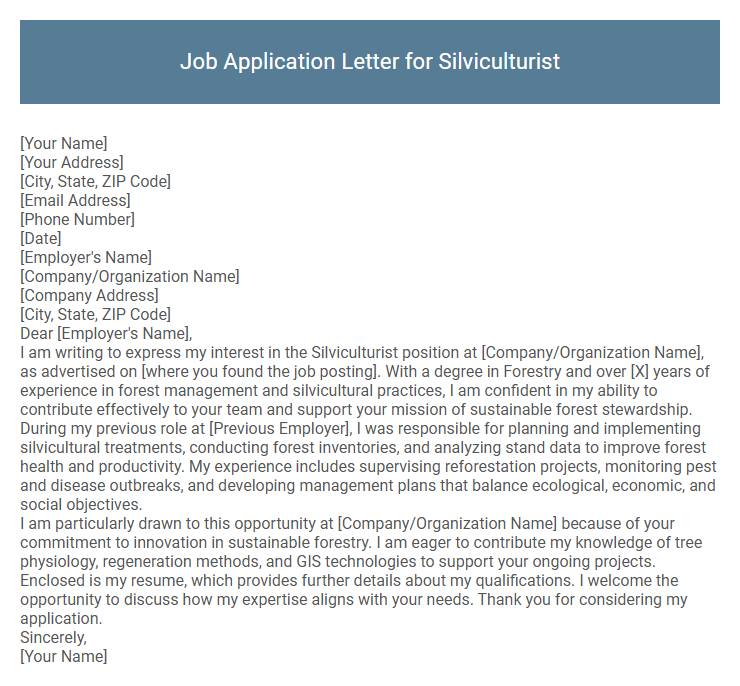
Job Application Letter for Silviculturist Sample
[Your Address]
[City, State, ZIP Code]
[Email Address]
[Phone Number]
[Date]
[Employer's Name]
[Company/Organization Name]
[Company Address]
[City, State, ZIP Code]
Dear [Employer's Name],
I am writing to express my interest in the Silviculturist position at [Company/Organization Name], as advertised on [where you found the job posting]. With a degree in Forestry and over [X] years of experience in forest management and silvicultural practices, I am confident in my ability to contribute effectively to your team and support your mission of sustainable forest stewardship.
During my previous role at [Previous Employer], I was responsible for planning and implementing silvicultural treatments, conducting forest inventories, and analyzing stand data to improve forest health and productivity. My experience includes supervising reforestation projects, monitoring pest and disease outbreaks, and developing management plans that balance ecological, economic, and social objectives.
I am particularly drawn to this opportunity at [Company/Organization Name] because of your commitment to innovation in sustainable forestry. I am eager to contribute my knowledge of tree physiology, regeneration methods, and GIS technologies to support your ongoing projects.
Enclosed is my resume, which provides further details about my qualifications. I welcome the opportunity to discuss how my expertise aligns with your needs. Thank you for considering my application.
Sincerely,
[Your Name]
A job application letter for a silviculturist highlights expertise in managing forest ecosystems and promoting sustainable forestry practices. It emphasizes skills in tree cultivation, forest regeneration, and ecological conservation to support environmental health and resource management. Demonstrating a strong background in silviculture and relevant experience positions the candidate as a valuable asset for forestry organizations.
What key qualifications should a Silviculturist highlight in a job application letter?
A Silviculturist should highlight expertise in forest ecology, tree biology, and sustainable forest management practices to ensure effective forest regeneration and conservation. Proficiency in using GIS technology, data analysis, and field assessment techniques demonstrates the ability to plan and monitor silvicultural treatments accurately. Strong knowledge of environmental regulations, forest policy, and experience in developing forest management plans are essential qualifications to emphasize for this role.
How do I format a job application letter for a Silviculturist position?
Formatting a job application letter for a Silviculturist position involves a clear structure and relevant content tailored to forestry expertise. The letter should highlight your knowledge in forest management and demonstrate how your skills meet the employer's needs.
Use a professional tone and standard business letter format, including your contact details, the employer's information, a formal greeting, and a concise closing.
- Contact Information - Include your name, phone number, email, and address at the top of the letter for easy correspondence.
- Introduction - State the position you are applying for and briefly mention your current role or relevant experience in silviculture.
- Body - Highlight specific skills such as forest ecology, regeneration techniques, and inventory management that align with the job description.
- Closing Paragraph - Express enthusiasm for the role and include a call to action inviting the employer to discuss your qualifications further.
- Signature - End with a formal closing like "Sincerely" followed by your typed name and signature if submitting a hard copy.
What essential skills should I mention as a Silviculturist applicant?
As a Silviculturist applicant, emphasize skills such as expertise in forest ecology, proficiency in tree planting and maintenance techniques, and strong knowledge of sustainable forestry practices. Highlight your ability to analyze forest growth patterns and implement effective silviculture treatments.
Demonstrate experience in using GIS and remote sensing technologies for forest management. Showcase skills in pest and disease identification and control as well as excellent data collection and reporting abilities. Strong communication and teamwork skills are essential for collaboration with environmental agencies and stakeholders.
What is the ideal length for a Silviculturist job application letter?
The ideal length for a Silviculturist job application letter is concise, typically around one page or 300-400 words. Keeping it brief ensures clear communication of qualifications without overwhelming the reader.
- Conciseness - A one-page letter efficiently presents key skills and experience relevant to silviculture.
- Focus - Maintaining 300-400 words allows emphasis on practical expertise and accomplishments in forest management.
- Readability - A shorter letter improves the chances of being fully read by hiring managers in competitive forestry positions.
Should I include certifications in my Silviculturist job application letter?
Including certifications in your Silviculturist job application letter strengthens your qualifications by showcasing relevant expertise and industry standards compliance. Highlight certifications such as Forestry Management, GIS, or Environmental Science to demonstrate specialized skills. Certifications provide employers with confidence in your technical abilities and commitment to sustainable forest management practices.
How do I express my knowledge of forest management in the letter?
Expressing knowledge of forest management in a job application letter for a Silviculturist role requires clear demonstration of expertise and practical experience. Highlight your understanding of ecosystem dynamics, sustainable practices, and forest policy implementation effectively.
- Showcase technical expertise - Describe specific silvicultural techniques you have applied to promote forest health and productivity.
- Illustrate sustainable management - Explain your experience in creating or following sustainable forest management plans balancing ecological and economic goals.
- Highlight policy knowledge - Mention familiarity with forestry regulations, environmental laws, and best practices in forest conservation.
Use concise examples linking your skills directly to the employer's forest management objectives to emphasize your suitability.
Is it necessary to mention specific tree species expertise?
Is it necessary to mention specific tree species expertise in a job application letter for a Silviculturist? Including expertise in specific tree species can enhance the application by demonstrating specialized knowledge relevant to the employer's forestry projects. Tailoring the letter to highlight this expertise aligns the candidate's skills with job requirements, increasing the chances of selection.
How do I demonstrate teamwork and leadership skills as a Silviculturist?
| Skills | Demonstration as a Silviculturist |
|---|---|
| Teamwork | Collaborate with forestry professionals and environmental scientists to design and implement forest management plans that enhance ecosystem health. |
| Leadership | Lead field teams during tree planting, thinning, and monitoring projects to ensure safety, efficiency, and adherence to silvicultural guidelines. |
| Communication | Facilitate clear communication between landowners, government agencies, and team members to align objectives and share progress updates. |
| Problem-Solving | Guide team efforts in adapting forest management techniques based on field data, environmental changes, and emerging pest threats. |
| Training | Conduct training sessions for new team members on silvicultural practices, safety protocols, and equipment usage, fostering skill development and confidence. |
What should I avoid including in my Silviculturist application letter?
Avoid including irrelevant personal details such as unrelated hobbies or excessive family information in your Silviculturist application letter. Steer clear of negative remarks about previous employers or job experiences.
Do not use vague statements or generic phrases that lack specific qualifications or accomplishments in silviculture. Avoid grammatical errors and overly complex jargon that could obscure your skills and expertise.